Gladie – No Need To Be Lonely | Album Review

Get Better Records

When things get bleak, you can talk to the chatbots. You can talk to the one your coworker uses for recipes and travel tips; you can talk to the one that lives in a necklace; you can talk to whatever the hell a Freakbob is. You can talk to them even when you can’t talk to fellow humans, when you’re ostracized at school, when your marriage is crumbling, or when you’re working long hours and haven’t seen your friends in weeks. And you can practically envision the misanthropic computer nerd, an odd sheen over his face, spittle flying from the corners of his mouth as he sells you this glorious vision of the future. The words unfurl as a threat: “There’s no need to be lonely.” Reassurance and menace, two sides of a coin.

Augusta Koch, the songwriter behind scrappy Philly DIY veterans Gladie, hears a similar dual meaning in this phrase. It’s the title of the band’s third album, invoked in both senses on the recent single “I Want That For You.” At the beginning of the song, Koch wanders the city at sunrise and marvels at its emptiness, eschewing human contact wherever possible. If she gets good enough at the temporary condition of being alone, she surmises, then perhaps she could negate the more permanent condition of loneliness. But she course-corrects immediately, clutching tightly to those who push her away, choosing friendship even at its most difficult: “If you stick around I’ll stick around / Now there’s no need to be lonely.” Understanding this tonal dichotomy leads directly to its refutation, humanism always outweighing its corresponding cynical refraction. 

Koch’s first band, Cayetana, was born out of friendship before any of the members had even picked up instruments. It would ultimately end in an effort to preserve that intimacy rather than surrender it to the stressors of a life in the arts. The group played pop-punk at a canted angle, the shaggy guitar chords offset by buoyant lead basslines (particularly instructive here is their 2017 split with like-minded trio Camp Cope). Koch wrote songs that reflected her immediate surroundings about the follies and foibles of Philadelphians in their mid-20s navigating romances, shitty jobs, and lives in the arts. She delivered her lyrics in a signature rasp, the kind of voice that immediately positioned her as a friend or peer. 

Gladie emerged from the wreckage as a collaboration between Koch and her longtime romantic partner Matt Schimelfenig. Her lyrics now tackled similar subject matter, albeit for a slightly older set, accounting for milestones like aging, sobriety, and the way in-groups diffuse over time. On Gladie’s last record, she penned one of the best indie rock songs in recent memory about wanting to separate herself from desire entirely. For its bridge, she turned early thirties existentialism, singing the endlessly relatable refrain “Do you feel it in your knees? / Does it settle in your gut?”

Friendship is a recurring theme in Koch’s writing, one she documents in almost survivalist terms, like on “Brace Yourself,” where she sings, “Instead I brace myself / To embrace you / To face you / To hear your voice.” In recent interviews, she’s extolled her love for the novelist and poet Ocean Vuong, honing in on Vuong’s idea that an artist’s entire body of work is often in service of answering key questions about that person. To hear Koch tell it, her writing is all about how to “remain an optimistic person who is also a depressed person.” It would also suggest that friendship is just about the best reason a depressed person could have for continued optimism.

For the first time, this “it takes a village” philosophy manifests itself in Gladie’s creative process. Beyond Koch and Schimelfenig, Gladie has always been fleshed out by a rotating cast of fellow Philly stalwarts, at times including members of Slaughter Beach Dog, Tigers Jaw, Spirit of the Beehive, and more. Currently, the lineup has solidified to include Evan Demianczyk on bass, Miles Ziskind on drums, and Liz Parsons on backing vocals. After hearing Koch’s new demos, longtime friend and DIY compatriot Jeff Rosenstock offered to man the boards for this record, and the crew decamped to record at Jack Shirley’s studio out in Oakland, CA. Koch pared her writing down, inspired by economical punks like The Marked Men, and surrendered more riff duty than ever to Schimelfenig. Rosenstock’s fingerprints can be found in the production through the sharpness of each instrument and the way Koch’s voice is situated therein. Where most prior Gladie releases layer her singing in reverb, fuzz, or pointed double tracking, her vocals here are dry and center-stage, putting more emphasis than ever on her tales of modern anxieties. 

These stories are at their sharpest when Koch interweaves her inner world with the one outside, such as when she likens her bouts of unnameable dread to broken car alarms, or later on the tracklist when poisonous air reinforces all of the self-doubt and broken dreams that accumulate over time. Conversely, she can occasionally veer into the language of therapy and pop psychology in ways that jar the listener out of the scene, like the reference to “people pleasing” on “Talk Past Each Other.” Luckily, these extremes are unified by a clear care for her subjects’ interiority, whether she’s writing about herself or others.

On “Future Spring,” Koch consoles a distraught companion by telling them, “Hey, you’re invited, and we’re glad you’re here.” To return briefly to the chatbots: sure, maybe one of these phantasms could conjure up a similar phrase if prompted for comforting words, but it couldn’t deliver that phrase with the conviction of a fellow person, one who has also felt pain and sadness. It couldn’t pour you a cup of coffee or hold you and cry, as Koch does earlier in the song. These gestures are what hold us together; the moments of solidarity between flesh-and-blood humans who struggle through modern life in the same ways. 

The last words uttered on No Need To Be Lonely are “Nostalgia’s just fool’s gold,” repeated over and over again on “Unfolding” like an incantation; a poignant idea as society collapses and people begin romanticizing the past. If things are ever going to improve for the people depicted in these songs, we will need to embrace each other and our flaws to imagine a future that is not just better than the present, but the past as well.

Jason Sloan is a guy from Brooklyn by way of Long Island. He’s on Twitter, and more of his writing can be found at Tributary.

more eaze – sentence structure in the country | Album Review

Thrill Jockey

On one of my family’s many trips to Southern California to visit my grandparents, we made our customary stop at Carpinteria Beach. Consumed with excitement, I burst out of the car the moment it stopped, scuttling towards the shore as fast as the uneven terrain would allow. The Pacific beckoned to me as a long-lost friend, pale green waves rushing to hug my short, sturdy legs. I smiled at the waving sea and noticed the way the sand felt between my toes. At my big age of six, I felt very important because I knew that the sand on these beaches was really just lots of tiny pebbles, so tiny that you couldn’t tell unless you looked really closely. Of course, looking really closely at things was my favorite pastime. I had recently received a child’s microscope for Christmas, complete with real slides and many delightful cross-sections to examine. The tide pools at this particular beach were another thing I liked looking closely at, each feeling like its own little microscope slide, a cross-section of the ocean that I loved so dearly. The textures, colors, and gentle motion within each pool enchanted me, and every visit provided some new fascination for my curious mind.

I have been drawn to texture and color in music for as long as I have loved the ocean. Every moment deserves precise decoration and shading, filled with a gentle motion that undulates without end as the tides do. I love music that swirls and crunches and buzzes and hums, any given moment displaying a vivid cross-section of its aural ecosystem. more eaze, the pen name of musician Mari Rubio, composes in this wonderful, variegated vein. Her most recent release, sentence structure in the country, is a beautiful and tapestried release that is yellow-warm with detail. Synthesizers, found sounds, string instruments, and vocals hang together like a dense kelp forest, every glitch and murmur precisely where it belongs. Rubio tapped musicians Alice Gerlach (cello), Jade Guterman (acoustic guitar), Ryan Sawyer (drums), Henry Earnest (electric guitar), and Wendy Eisenberg (piano, vocals, electric guitar) to realize the artistic vision alongside her.

Last year, I had the privilege of reviewing one of Mari’s previous albums, No Floor, a collaborative release with ambient artist claire rousay. The detailed, thoughtful placement of each sound throughout that album deeply impressed me. This type of composing is especially challenging, as it requires an innate understanding of the balance and relationship between each sound chosen for a song. You have to be able to achieve depth without busyness, clarity without sounding shallow, and intention without becoming predictable. The talent I observed from more eaze on No Floor is reflected and amplified on sentence structure in the country

The album opens with “leave (again),” a track lush with synth effects, pleasingly autotuned vocals, and emotive strings. It’s an incredibly impactful opener, immediately pulling the listener inside more eaze’s world, succinct and organized like the tide pools of my youth. “If you only knew why I lock the doors / You’d say it's illogical / and I’d say of course,” Mari hums as a melancholic synth organ repeats a rising melody line. “I’d say let’s go outside / but it’s far too warm.” Static crackles over these words, and I am reminded of one of my favorite perfumes, Warm Bulb by Clue. The perfume has a note called “burning dust” that fizzes in my nostrils and makes my nose wrinkle in the best way. It smells like a hot attic and old vanilla. This is exactly how “leave (again)” feels; the static hum is warm, dusty, and comforting, Mari’s vocals soothe, and the entire effect is incandescently cozy. 

This intimate mood shifts on the second track, “distance,” where the atmosphere is immediately cooler, sparser, and more reserved. Dense, blurred harmonies fill the piece's background like fog, inviting yet unimpenetrable. The lyrics of “distance” capture the unsettling feeling of growing apart from a friend or even completely losing a relationship. Life rushes on regardless, but there are subtle shifts in routine as certain things, once so significant, become mundane or disappear entirely. more eaze’s vocals create an otherworldly ambiance as they melt into the surrounding landscape of sound.

from the ground
to the stairs
one time
the last time

four o clock
for me
means something less to you

the scene changes
but mood
does not improve

“distance” is a track on this album that I have already found myself returning to regularly. I wish to fall into the song and let its velvety grey fog surround me, catching me mid-air as the alien atmosphere captivates every sense. This is what sets the work of more eaze apart — she creates landscapes, microcosms, dioramas. Each track is a glimpse of a world in miniature, a tide pool of sound and texture and emotion. 

more eaze continues her exploration of these worlds on “biters,” which stands in stark contrast to the atmosphere of “distance.” This particular microcosm is metallic, and as I listen with my eyes closed, I feel as if I am standing in the middle of a post-apocalyptic wasteland. There is something large and ominous looming ahead, and there is something else much faster than I, roaring past. The wind whips my legs and pulls the jacket on my back taut against my skin. Electronic sounds glitch and garble through my ears. I wince as everything starts to sound closer and louder, but there is something familiar too. A smooth vocal line weaves its way through the chaos and razor edges of the noises crowding against my ears. Everything — the sounds, the voice, the volume — presses against my eardrums until it is almost too much, and then suddenly it is quiet. A breath, and a twangy guitar jangles in my ears. Where am I now? Drums skitter behind me like a tumbleweed and violins warm the air. There is singing again, raw and very close by. Everything crashes against my ears once more, but now I am floating, and I feel something like the sun against my eyelids. The whir of something fast intertwines with the guitar, acoustic against electronic. The air is very hot. I open my eyes as the dust settles and I am back on Earth.

a chorale” is the world I love most on the journey this album takes. I have always been peculiarly drawn to works for strings, marveling at the depth of feeling that such simple instruments can create. Works like the evergreen “Adagio for Strings” by Barber, “Violin Concerto No. 1” by Philip Glass, and “Different Trains” by Steve Reich all hold a treasured place in my heart. They are moving to the point of being gut-wrenching, but I find myself returning to this sort of work again and again anyway. Because of this, I was delighted when the raw opening notes of “a chorale” met my ears for the first time. This piece is like coming upon a sunlit clearing in a dense forest, feeling the air suddenly warm around you and watching the light dance through it. This fleeting, gorgeous track ends with a poignant sustained note that feels like a heartbreak. As the echoes of that final note still resonate in my head, the next track, “healing attempt,” immediately shifts to a sunrise-warm synth. Little glitches scintillate through the beginning of the song as mari sings, “Princess of the texture / is looking quite vexed / at last year’s biography / It’s not a good mixture / when you win Best Picture for making a fool of me.” Suddenly, the song shifts stylistically, adding twangy acoustic guitar and background vocals that are charmingly reminiscent of Sufjan Stevens. “healing attempt” is a clever, tongue-in-cheek dissection of navigating growing fame and recognition, recognizing that it is just “the same hollow entry to something new.”

For the entire album so far, I have pondered the meaning of the title. What is sentence structure in the country? I like ambiguous, abstract concepts in art, so it appealed to me immediately; however, I also wanted to figure out the hidden meaning, so I was excited to finally listen to the title track. Though solely instrumental, this piece feels like bearing witness to a heated conversation. Strings slide and snap, skittering melodies are plucked on a guitar, electronic sounds murmur and scoff. A fiddle tune begins to worm its way into the piece, becoming more agitated, rushing through a fiery jig as the argument continues. It becomes obvious that, though the title seemed abstract to me at first, this song captures the precise feeling of sentence structure in the country. This is a brilliantly executed idea: the explanation of the title is saved until the penultimate track, and though “sentence structure” implies the use of language and grammar, more eaze achieves this reveal without using either. 

Tide pools fill at high tide and meet their mother ocean again. These tiny worlds become part of the vast Pacific, though but for a few hours. sentence structure in the country is filled with exquisitely crafted songs that each stand as their own tide pool, but together they swirl and froth into something bigger and even more beautiful. Mari Rubio has once again proven her mastery in creating immersive, thoughtful works of art with this release.

I sense that the tide is rolling in as the waves swirling around my sandy legs feel a little more eager than before, and I carefully wave goodbye before running up the sand.


Britta Joseph is a musician and artist who, when she isn’t listening to records or deep-diving emo archives on the internet, enjoys writing poetry, reading existential literature, and a good iced matcha. You can find her on Instagram @brittajoes.

Sella – Well I Mean | Album Review

Bar/None Records

“Biggest rule of two-song Tuesday—where’s Brian? … Brian?”
“Everyone say ‘Brian’ really loud. One, two, three…”
BRIAN!!!

These are the opening seconds of Well I Mean, the first album of Brian Sella’s mononymous new solo project, Sella. You might recognize that name as the singing and guitar-playing half of The Front Bottoms, and while he’s still unmistakably himself throughout this new venture, we find him in a completely new soundscape. According to Bar/None Records, this album was recorded “to amuse the muse, to re-find the fun and deliver something personal to the listener.” This music is pretty in a way that TFB has never ever been; it’s wholly its own, and completely sheds any baggage it might have had coming from a frontman of an established act, though it might take the listener a few passes to come to terms with that.

As someone who’s read, sung, hummed, cried, and shouted every TFB lyric, I feel pretty confident saying that Brian’s characters are always asking themselves questions: where they are, where they want to be, how they’re going to get there. This album is a fresh start, and it knows it, reflecting on lessons learned the hard way, advice accumulated over the years, and overflowing with gratitude for the people who stuck through it all. 

Sonically, Well I Mean is a brass-dominant 25-minute jaunt that dispenses with the usual guitar-forward sound of TFB, opting instead for a softer style with plucky strings, shiny horns, and upright piano. Lyrically, there’s still a spool of matter-of-fact wisdom, picked up in remote places and doled out in an introspective, storytelling style. At times abstract, and at others more concrete than an ocean, Well I Mean could take a few listens to pick apart, but don’t worry, self-help has never sounded catchier.

After the opening shout, we get into the music with the faraway and somewhat regretful “American Shark.” We’re brought in with a shimmering set of strings, accompanied by a simple finger-picked melody, setting the tone as pensive and self-assuredly unworthy. Brian then immediately upends this table-setting with “Skipping Out,” which is ridiculously bright, youthful, and full of color. This is primarily thanks to the cornet, which you first hear in the call-and-response with the lyrics, “Falling into a nice routine / I’m drunk every time you see me.” The cornet lingers and builds in the verse, then lithely breaks away to support the piano in the chorus, “It seems / I’ve been lookin’ at things reversed / this whole time / So much so that at this point / the right way just don’t feel right.” It evokes the feeling of dancing at a celebration of life, summoning joy on a day meant for mourning. Positive tunes to losing-it-a-little lyrics is a classic juxtaposition very much in the TFB wheelhouse, now masterfully rendered in a new domain, setting the album on a firm foundation of its own. 

A little later on, we hear the similarly light and jubilant “South Dakota.” If you’re from a rural part of a landlocked state like me, you should understand immediately that roads, highways, and interstates are our lifelines to other people, hence the metaphor “The ocean is the highway.” Even in 2026, there are miles and miles of dead zones where you’re left to contemplate why you’re on that road in the first place. In the bridge, the narrator shares a revelation he had out there: “You finally realize / life’s but a dream / But exactly how you’re feeling / ain’t exactly how it seems.” Notably, “All that we see or seem / is but a dream within a dream” comes from Edgar Allen Poe’s A Dream Within a Dream. I think the narrator of “South Dakota” is assuring themself that emotions are not our reality; with time and experience, the difficult ones will pass.

Obviously a huge part of Well I Mean are the trumpets (or cornets, or flugelhorns). They have a literally instrumental role in a third of the songs on the album, most notably on “Perfect Worth It,” at first in support of the narrator, then fully taking over and playing out into a silvery conclusion. In researching for this review, I actually couldn’t believe that the last three TFB albums don’t have brass at all. The most recent song in their discography with a trumpet is “Don’t Fill Up On Chips” from Going Grey, then “The Plan (Fuck Jobs)” and “2YL,” both from Back on Top, around 10 years ago. It’s poetic for the brass on Well I Mean to be so good, because it was inspired directly by the intentionally amateurish brass sounds in TFB’s early catalog, namely “Flashlight,” “12 Feet Deep,” and “Swear to God the Devil Made Me Do It.” This album is orchestral in a way that we only saw glimpses of in early TFB. The best example is “Maps” from their self-titled album, which uses strings and simple piano to get about halfway to the style of Well I Mean. Now, Brian has made it out of his room, onto his big, big plans.

Well I Mean was produced by the prolific and incredibly cool Chad Matheny, of the DIY folk-punk band Emperor X. Actually, the music video for “Perfect Worth It” was a part of a joint release, with Emperor X publishing “Pissing With the Flashlight On” on Bar/None Records the same day, which details the darkly humorous realities of the all-too-real evil in our world. Emperor X and Sella have a short tour together this spring, and, in one final piece of kismet, it’s not the first time they’ve been on the road together. About 15 years ago, Emperor X and The Front Bottoms went on a DIY tour, which you can read a bit about in this interview from The Aquarian. This long friendship bearing fruit couldn’t summarize the album any better; dipping into the past for inspiration, finding new ways to be yourself, and creating something at once bathed in history and completely unique. 

At the beginning of this review, I mentioned Brian’s intent with this solo excursion was to “refind the fun.” In that same Bar/None Records page, they open by talking about the distance between the stage and the bedroom. Throughout, I’ve referred to Brian as, well, Brian. It felt so odd to call him Sella, even though that would be the correct “journalistic practice.” To me, he’s an everyman; he could be my eccentric neighbor, my favorite buddy’s favorite buddy, or the mailman. His songs have always seemed like something a friend of a friend could have made and played in a garage or backyard. Those qualities are most obvious to me in TFB’s earliest on-label works, The Front Bottoms and Talon of the Hawk, which Brian magically channeled into Well I Mean

For example, on their self-titled album from 15 years ago, The Front Bottoms built their album closer, “Hooped Earrings,” around voicemails. They’ve had voice samples here and there throughout their discography since, and now Sella uses this trick again, building a full song around a voicemail in “Stocking Up.” Actually, what we’re privy to sounds more like a deposition, which, oddly enough, also sounds like directions for a DIY music video. In it, we hear the lines, “You got a gun in your hands / but it should be a guitar” and “At this point giving up the gun / should be easy to do / Don’t worry, just know / I’ve got another you could use.” At first, I thought this meant another gun, but I think the narrator is saying he wants to help his friend change, letting them know that if they want to change, he’ll support them. It might seem like a reach, but I think it actually falls nicely into place if you consider the line, “I’m sure that we could find something for you to do on stage / Maybe shake a tambourine or when I sing, you sing harmonies” from TFB’s most famous song, “Twin Size Mattress.” These are the same sentiments: making space in your life to help someone, even going so far as to let them join your band if it means they can get better.

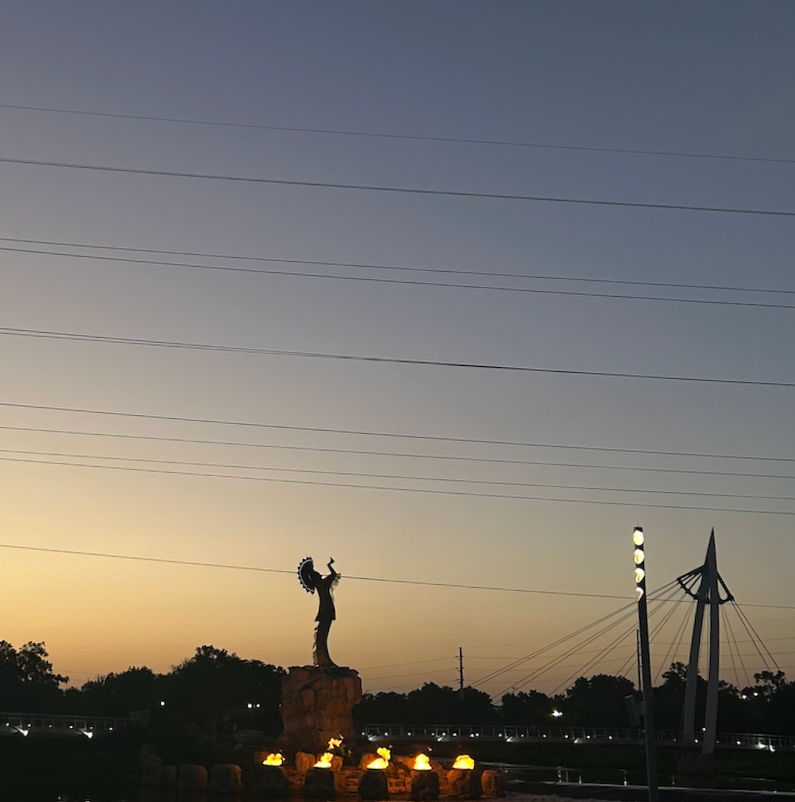
While we’re on the abstract stuff, two quick notes about the stream-of-consciousness track “Wichita.” First, the line “If you were brave enough / to drink the Arkansas / you cast a shadow / on the river like an art piece” refers to the Keeper of the Plains on the Arkansas River in downtown Wichita, Kansas, about 30 miles from my hometown. Second, I couldn’t help but notice the similarity between the Yogi Berra quote “You can observe a lot by just watching,” and the line “Walk around from light to dark / you see a lot.” Neither of these guys are trying to be profound; they are kindred spirits articulating how they see the world, and through their matter-of-fact descriptions, they arrive at somewhat profound (if at times cockeyed) conclusions.

THE KEEPER OF THE PLAINS ON THE ARKANSAS RIVER IN WICHITA, KANSAS. PHOTO BY ANNA WATSON.

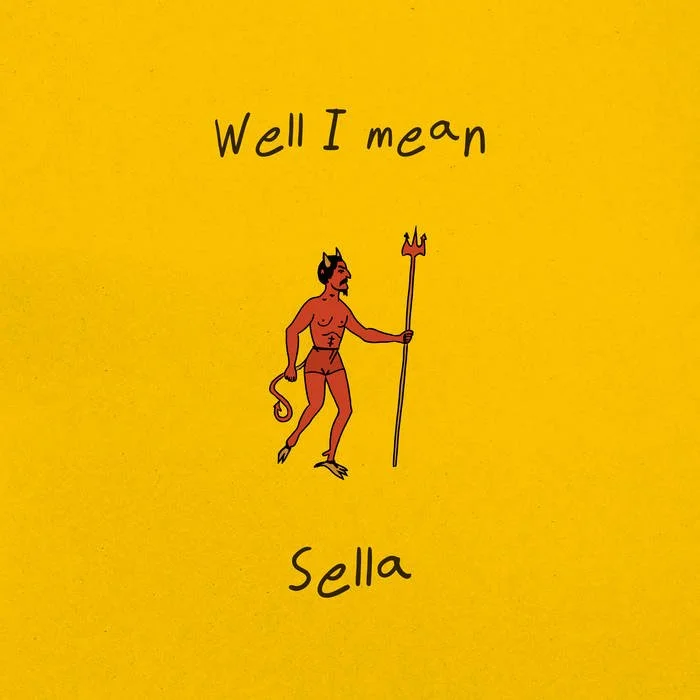
One track before the end of the album is “Daredevil.” This is the second time the narrator directly refers to himself as the devil, saying, “I was the same old snake / We made a cute couple / and a couple mistakes.” The first instance can be found in the opener “American Shark” where Brian says, “I feel like I am the devil / and I’ve got an angel / lying next to me.” Also, Captain Obvious has indicated to me that there is a devil even on the album cover, how subtle. Where other tracks used rhythm guitar or Latin percussion to keep time, “Daredevil” uses a drum machine, breaking sharply with the rest of the album. 

While I really do think it stands on its own, making space for a new sound with a matured voice and musical style, there is a rich web of connections to older TFB songs. In some ways, Brian’s always talking about the same ideas, but—miraculously—he keeps it fresh. After all, he told us a long time ago, “Freshness is expected from any hip-hop artist.” Brian is always saying something new, even when it’s the same, or as he puts it on “Daredevil”: “But this new normal / is under heavy disguise.”

Earlier, we got the line “Walk around in circles / like I’m trying to walk my manic out / Talk to all my problems / but I’m only talking to myself” from “Skipping Out,” which now pairs nicely with “In my life and in my mind / endless running around / chasing highs.” The majority of the narrator’s perspective in this album can be explained by just these two songs. It seems that they suffer from bipolar depression, experiencing mania, chasing highs, fucking up, blaming themselves, getting depressed, and repeating the cycle. These two songs alone tell us the album is about recognizing wrongs and trying to be better, and just about every other lyric on the album supports that conclusion. 

In all, Well I Mean is a shining example of what 15 years of growth looks like, both personally and musically—waking up, approaching healing as a process, and making a choice every single day to get better and to be better. The album doesn’t sugarcoat the slip-ups, but the narrator’s best days are not begrudged to them. It ends with a winding ambient track helpfully called “Untitled,” which I believe contains audio from a eulogy. In it, the priest says, “It was one of the saints that said, ‘Music is the only art of heaven we can experience on Earth, and the only art of Earth that we will take with us to heaven.’” But I think this is a paraphrase of something normally attributed to the 18/19th century English poet Walter Savage Landor, who once wrote, “Music is God's gift to man, the only art of Heaven given to Earth, the only art of Earth we take to Heaven.” I make the point of crediting the poet because Brooklyn Vegan quoted Brian recently as saying, “I’m a poet first and foremost, so my focus is always on communicating something emotionally and artistically.” I’ve always thought that about him, but I’m glad to know he thinks it about himself, too.


Braden Allmond is a particle physicist and emo music enthusiast. He anticipates graduating from KSU in August with a PhD in experimental high energy physics. When he isn’t writing his thesis, he’s data-scraping articles and books about emo music, making tables and graphs to interrogate and understand the genre.

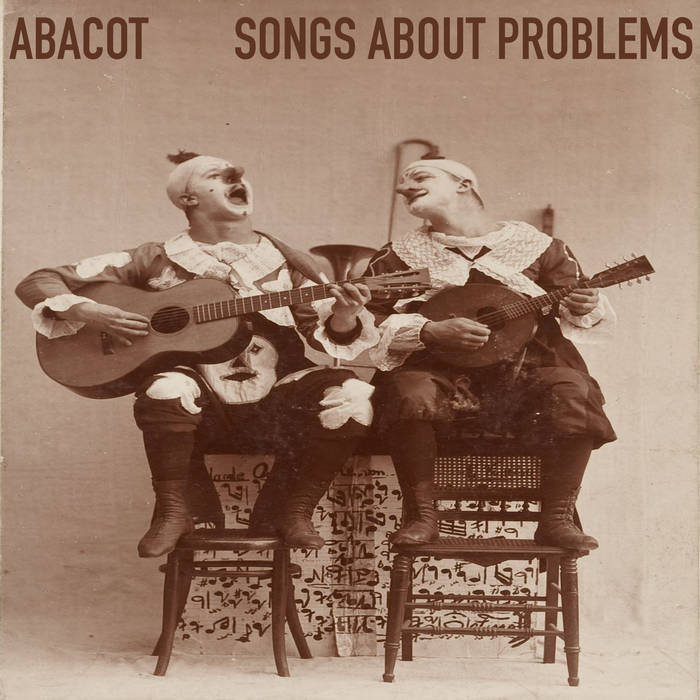
Abacot – Songs About Problems | Album Review

Abacot and Many Hats Distribution

It’s been almost three years, but I still remember where I was when I first heard Abacot’s EP Promo 2023. I had just hiked over a bridge for a mile in direct sunlight, and it was only getting hotter as I tried to get through my dreaded commute. I made the mistake of wearing a cloying polyester dress, and mosquitoes were tearing me up as I descended the endless Woodley Park-Zoo/Adams Morgan escalator. Ultimately, it was just a regular Tuesday in July. I waited for the train, squeezed in, and, naturally, the A.C. was out. I checked my phone while crammed between two businessmen and saw that Swim Into The Sound had reviewed a new EP from a band in the DMV, so I listened to the whole thing through the rest of my commute. I was late for work.

It’s been a couple of years and change since I was sweating it out on that train, and Abacot has returned with a follow-up to that EP today — Songs About Problems is here in all of its bright and bitter glory. For those out of the loop, Abacot is a project helmed by Claudio Benedi, the former frontman of D.C.’s beloved Commander Salamander. Abacot always feels like a true puzzle piece to understanding the larger regional rock sound: this album was produced and engineered by Ryland Heagy, and better yet, when they perform live, their shows are stacked with familiar faces from the world of DMV music (think Combat, think Origami Angel).

Songs About Problems picks up where Promo 2023 left off. While it still features the three songs from that initial EP (with some rerecording), the concentrated misery underpinning all of Promo 2023 is expanded into a rounder emotional release. Benedi totally recontextualizes the initial project – one born out of grief, betrayal, and banality – and transforms it into an examination of difficult personal growth after these dark moments have passed. Beyond the inimitable ear of Ryland Heagy, this album was mixed by Drew Portalatin, the mastermind behind Origami Angel’s mixtape The Brightest Days and Combat’s instant thrasher classic, Stay Golden. It was also mastered by Will Yip, fresh off his Grammy win for Turnstile’s NEVER ENOUGH —a combination that instantly pushes Songs About Problems into an echelon of undeniable ragers.

Sonically, Songs About Problems starts somewhere in 2001 or maybe 2003; I’m still debating the exact year, but it was definitely when you could buy checkered wristbands at Hot Topic, guys in emo bands wore collared shirts, and it was mandatory to spike your hair like Deryck Whibley. The lyrics of “Remember When” match this nostalgic sound as Benedi reflects on the distance between him and a former friend. What starts as something The Starting Line-adjacent switches up mid-song, and Benedi shows off his guitar prowess, a sound distinctly reminiscent of that early ‘20s emo sound he helped popularize, across the bridge.

The frustration of “Remember Me” softens into “One Way Street,” a daringly optimistic song. Benedi is a very talented musician, and one of his undeniable strengths is his ability to create absolute earworms. After just one listen to the chorus, I caught myself singing along to that helplessly catchy, “And I’m yours / are you mine?” on the second spin. The song chugs along, evoking a kind of Fountains of Wayne-style build before opening into “Check Engine Light” and “Vertigo” from Promo EP

These songs have lived on my shelf and in my playlists for three years, and they are still just as electric as they were when I first listened to them on that Metro ride. I’ve thought about “Check Engine Light” every time I can’t get my car engine to turn over when it gets a bit too cold out. “Vertigo,” devastating yet unafraid to get a little King of the Hill-theme song with it, has been perpetually stuck in my head since the first time I heard Benedi sing “I see all your lies / I see through your disguise!” 

After revisiting these tracks from the Promo EP, we have some songs that totally reorient the Abacot project from something wrought with nausea and exhaustion into a broader, more pop-bent with begrudging positivity. “Vertigo” launches into the anthemic, arena-rock “Show You,” molding Benedi’s shapeshifting agony into a single question: “I freed my heart / what about you?” On “Iridescent,” he flexes his Bowling For Soup-y humor over a song that could easily soundtrack a Tony Hawk Pro Skater game, and the synths on “Drifter” take the whole album to Saturn and back.

In Swim Into The Sound’s initial review, Taylor Grimes aptly diagnosed how “When people think of ‘emo music,’ they tend to think of sappy, tappy, whiny bullshit. That’s all well and good, but it’s SUMMER, and the people need something light, something they can sing along to with the windows down.” That’s what “Horror,” the third song from Promo EP, does. While the other two carryover songs are visceral in their anguish, “Horror” is hauntingly hopeful. Benedi soars into the song as he sings, “If we’re going to make it / I know we’re gonna make it to the end.”

“Horror,” in this new context, provides the perfect aerial arc for the album’s ending on the titular “Songs About Problems.” I wouldn’t call it a positive or even a helpful song, any more than I’d call this album particularly optimistic, but it’s honest and self-assured. Benedi doesn’t necessarily regret these difficult years, but that doesn’t mean that the outcomes don’t still hurt. Instead, he diffuses what frustrates him the most and recognizes it in others. We will get through this together.

I don’t live in D.C. anymore and no longer have to do that long commute, but for one day, I wish I could do it one more time, listening to Songs About Problems.


Caro Alt (she/her) is from New Orleans, Louisiana, and if she could be anyone in The Simpsons, she would be Milhouse.