more eaze – sentence structure in the country | Album Review
/
Thrill Jockey
On one of my family’s many trips to Southern California to visit my grandparents, we made our customary stop at Carpinteria Beach. Consumed with excitement, I burst out of the car the moment it stopped, scuttling towards the shore as fast as the uneven terrain would allow. The Pacific beckoned to me as a long-lost friend, pale green waves rushing to hug my short, sturdy legs. I smiled at the waving sea and noticed the way the sand felt between my toes. At my big age of six, I felt very important because I knew that the sand on these beaches was really just lots of tiny pebbles, so tiny that you couldn’t tell unless you looked really closely. Of course, looking really closely at things was my favorite pastime. I had recently received a child’s microscope for Christmas, complete with real slides and many delightful cross-sections to examine. The tide pools at this particular beach were another thing I liked looking closely at, each feeling like its own little microscope slide, a cross-section of the ocean that I loved so dearly. The textures, colors, and gentle motion within each pool enchanted me, and every visit provided some new fascination for my curious mind.
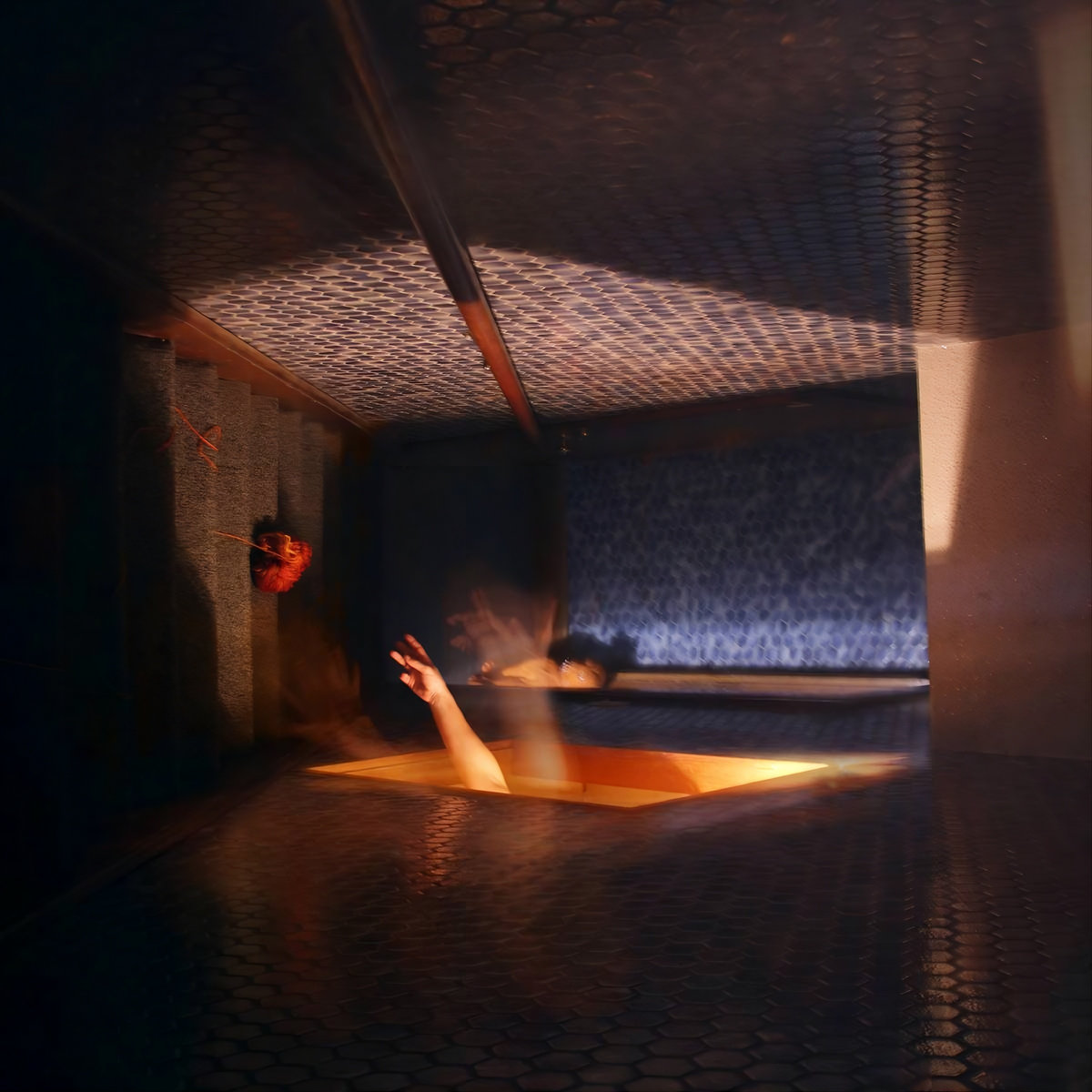
I have been drawn to texture and color in music for as long as I have loved the ocean. Every moment deserves precise decoration and shading, filled with a gentle motion that undulates without end as the tides do. I love music that swirls and crunches and buzzes and hums, any given moment displaying a vivid cross-section of its aural ecosystem. more eaze, the pen name of musician Mari Rubio, composes in this wonderful, variegated vein. Her most recent release, sentence structure in the country, is a beautiful and tapestried release that is yellow-warm with detail. Synthesizers, found sounds, string instruments, and vocals hang together like a dense kelp forest, every glitch and murmur precisely where it belongs. Rubio tapped musicians Alice Gerlach (cello), Jade Guterman (acoustic guitar), Ryan Sawyer (drums), Henry Earnest (electric guitar), and Wendy Eisenberg (piano, vocals, electric guitar) to realize the artistic vision alongside her.
Last year, I had the privilege of reviewing one of Mari’s previous albums, No Floor, a collaborative release with ambient artist claire rousay. The detailed, thoughtful placement of each sound throughout that album deeply impressed me. This type of composing is especially challenging, as it requires an innate understanding of the balance and relationship between each sound chosen for a song. You have to be able to achieve depth without busyness, clarity without sounding shallow, and intention without becoming predictable. The talent I observed from more eaze on No Floor is reflected and amplified on sentence structure in the country.
The album opens with “leave (again),” a track lush with synth effects, pleasingly autotuned vocals, and emotive strings. It’s an incredibly impactful opener, immediately pulling the listener inside more eaze’s world, succinct and organized like the tide pools of my youth. “If you only knew why I lock the doors / You’d say it's illogical / and I’d say of course,” Mari hums as a melancholic synth organ repeats a rising melody line. “I’d say let’s go outside / but it’s far too warm.” Static crackles over these words, and I am reminded of one of my favorite perfumes, Warm Bulb by Clue. The perfume has a note called “burning dust” that fizzes in my nostrils and makes my nose wrinkle in the best way. It smells like a hot attic and old vanilla. This is exactly how “leave (again)” feels; the static hum is warm, dusty, and comforting, Mari’s vocals soothe, and the entire effect is incandescently cozy.
This intimate mood shifts on the second track, “distance,” where the atmosphere is immediately cooler, sparser, and more reserved. Dense, blurred harmonies fill the piece's background like fog, inviting yet unimpenetrable. The lyrics of “distance” capture the unsettling feeling of growing apart from a friend or even completely losing a relationship. Life rushes on regardless, but there are subtle shifts in routine as certain things, once so significant, become mundane or disappear entirely. more eaze’s vocals create an otherworldly ambiance as they melt into the surrounding landscape of sound.
from the ground
to the stairs
one time
the last time
four o clock
for me
means something less to you
the scene changes
but mood
does not improve
“distance” is a track on this album that I have already found myself returning to regularly. I wish to fall into the song and let its velvety grey fog surround me, catching me mid-air as the alien atmosphere captivates every sense. This is what sets the work of more eaze apart — she creates landscapes, microcosms, dioramas. Each track is a glimpse of a world in miniature, a tide pool of sound and texture and emotion.
more eaze continues her exploration of these worlds on “biters,” which stands in stark contrast to the atmosphere of “distance.” This particular microcosm is metallic, and as I listen with my eyes closed, I feel as if I am standing in the middle of a post-apocalyptic wasteland. There is something large and ominous looming ahead, and there is something else much faster than I, roaring past. The wind whips my legs and pulls the jacket on my back taut against my skin. Electronic sounds glitch and garble through my ears. I wince as everything starts to sound closer and louder, but there is something familiar too. A smooth vocal line weaves its way through the chaos and razor edges of the noises crowding against my ears. Everything — the sounds, the voice, the volume — presses against my eardrums until it is almost too much, and then suddenly it is quiet. A breath, and a twangy guitar jangles in my ears. Where am I now? Drums skitter behind me like a tumbleweed and violins warm the air. There is singing again, raw and very close by. Everything crashes against my ears once more, but now I am floating, and I feel something like the sun against my eyelids. The whir of something fast intertwines with the guitar, acoustic against electronic. The air is very hot. I open my eyes as the dust settles and I am back on Earth.
“a chorale” is the world I love most on the journey this album takes. I have always been peculiarly drawn to works for strings, marveling at the depth of feeling that such simple instruments can create. Works like the evergreen “Adagio for Strings” by Barber, “Violin Concerto No. 1” by Philip Glass, and “Different Trains” by Steve Reich all hold a treasured place in my heart. They are moving to the point of being gut-wrenching, but I find myself returning to this sort of work again and again anyway. Because of this, I was delighted when the raw opening notes of “a chorale” met my ears for the first time. This piece is like coming upon a sunlit clearing in a dense forest, feeling the air suddenly warm around you and watching the light dance through it. This fleeting, gorgeous track ends with a poignant sustained note that feels like a heartbreak. As the echoes of that final note still resonate in my head, the next track, “healing attempt,” immediately shifts to a sunrise-warm synth. Little glitches scintillate through the beginning of the song as mari sings, “Princess of the texture / is looking quite vexed / at last year’s biography / It’s not a good mixture / when you win Best Picture for making a fool of me.” Suddenly, the song shifts stylistically, adding twangy acoustic guitar and background vocals that are charmingly reminiscent of Sufjan Stevens. “healing attempt” is a clever, tongue-in-cheek dissection of navigating growing fame and recognition, recognizing that it is just “the same hollow entry to something new.”
For the entire album so far, I have pondered the meaning of the title. What is sentence structure in the country? I like ambiguous, abstract concepts in art, so it appealed to me immediately; however, I also wanted to figure out the hidden meaning, so I was excited to finally listen to the title track. Though solely instrumental, this piece feels like bearing witness to a heated conversation. Strings slide and snap, skittering melodies are plucked on a guitar, electronic sounds murmur and scoff. A fiddle tune begins to worm its way into the piece, becoming more agitated, rushing through a fiery jig as the argument continues. It becomes obvious that, though the title seemed abstract to me at first, this song captures the precise feeling of sentence structure in the country. This is a brilliantly executed idea: the explanation of the title is saved until the penultimate track, and though “sentence structure” implies the use of language and grammar, more eaze achieves this reveal without using either.
Tide pools fill at high tide and meet their mother ocean again. These tiny worlds become part of the vast Pacific, though but for a few hours. sentence structure in the country is filled with exquisitely crafted songs that each stand as their own tide pool, but together they swirl and froth into something bigger and even more beautiful. Mari Rubio has once again proven her mastery in creating immersive, thoughtful works of art with this release.
I sense that the tide is rolling in as the waves swirling around my sandy legs feel a little more eager than before, and I carefully wave goodbye before running up the sand.
Britta Joseph is a musician and artist who, when she isn’t listening to records or deep-diving emo archives on the internet, enjoys writing poetry, reading existential literature, and a good iced matcha. You can find her on Instagram @brittajoes.