Sella – Well I Mean | Album Review
/
Bar/None Records
“Biggest rule of two-song Tuesday—where’s Brian? … Brian?”
“Everyone say ‘Brian’ really loud. One, two, three…”
“BRIAN!!!”
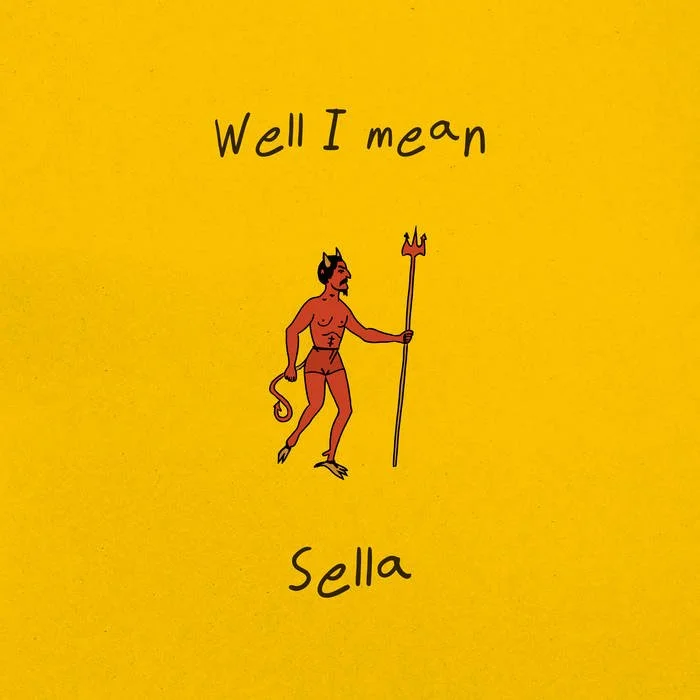
These are the opening seconds of Well I Mean, the first album of Brian Sella’s mononymous new solo project, Sella. You might recognize that name as the singing and guitar-playing half of The Front Bottoms, and while he’s still unmistakably himself throughout this new venture, we find him in a completely new soundscape. According to Bar/None Records, this album was recorded “to amuse the muse, to re-find the fun and deliver something personal to the listener.” This music is pretty in a way that TFB has never ever been; it’s wholly its own, and completely sheds any baggage it might have had coming from a frontman of an established act, though it might take the listener a few passes to come to terms with that.
As someone who’s read, sung, hummed, cried, and shouted every TFB lyric, I feel pretty confident saying that Brian’s characters are always asking themselves questions: where they are, where they want to be, how they’re going to get there. This album is a fresh start, and it knows it, reflecting on lessons learned the hard way, advice accumulated over the years, and overflowing with gratitude for the people who stuck through it all.
Sonically, Well I Mean is a brass-dominant 25-minute jaunt that dispenses with the usual guitar-forward sound of TFB, opting instead for a softer style with plucky strings, shiny horns, and upright piano. Lyrically, there’s still a spool of matter-of-fact wisdom, picked up in remote places and doled out in an introspective, storytelling style. At times abstract, and at others more concrete than an ocean, Well I Mean could take a few listens to pick apart, but don’t worry, self-help has never sounded catchier.
After the opening shout, we get into the music with the faraway and somewhat regretful “American Shark.” We’re brought in with a shimmering set of strings, accompanied by a simple finger-picked melody, setting the tone as pensive and self-assuredly unworthy. Brian then immediately upends this table-setting with “Skipping Out,” which is ridiculously bright, youthful, and full of color. This is primarily thanks to the cornet, which you first hear in the call-and-response with the lyrics, “Falling into a nice routine / I’m drunk every time you see me.” The cornet lingers and builds in the verse, then lithely breaks away to support the piano in the chorus, “It seems / I’ve been lookin’ at things reversed / this whole time / So much so that at this point / the right way just don’t feel right.” It evokes the feeling of dancing at a celebration of life, summoning joy on a day meant for mourning. Positive tunes to losing-it-a-little lyrics is a classic juxtaposition very much in the TFB wheelhouse, now masterfully rendered in a new domain, setting the album on a firm foundation of its own.
A little later on, we hear the similarly light and jubilant “South Dakota.” If you’re from a rural part of a landlocked state like me, you should understand immediately that roads, highways, and interstates are our lifelines to other people, hence the metaphor “The ocean is the highway.” Even in 2026, there are miles and miles of dead zones where you’re left to contemplate why you’re on that road in the first place. In the bridge, the narrator shares a revelation he had out there: “You finally realize / life’s but a dream / But exactly how you’re feeling / ain’t exactly how it seems.” Notably, “All that we see or seem / is but a dream within a dream” comes from Edgar Allen Poe’s A Dream Within a Dream. I think the narrator of “South Dakota” is assuring themself that emotions are not our reality; with time and experience, the difficult ones will pass.
Obviously a huge part of Well I Mean are the trumpets (or cornets, or flugelhorns). They have a literally instrumental role in a third of the songs on the album, most notably on “Perfect Worth It,” at first in support of the narrator, then fully taking over and playing out into a silvery conclusion. In researching for this review, I actually couldn’t believe that the last three TFB albums don’t have brass at all. The most recent song in their discography with a trumpet is “Don’t Fill Up On Chips” from Going Grey, then “The Plan (Fuck Jobs)” and “2YL,” both from Back on Top, around 10 years ago. It’s poetic for the brass on Well I Mean to be so good, because it was inspired directly by the intentionally amateurish brass sounds in TFB’s early catalog, namely “Flashlight,” “12 Feet Deep,” and “Swear to God the Devil Made Me Do It.” This album is orchestral in a way that we only saw glimpses of in early TFB. The best example is “Maps” from their self-titled album, which uses strings and simple piano to get about halfway to the style of Well I Mean. Now, Brian has made it out of his room, onto his big, big plans.
Well I Mean was produced by the prolific and incredibly cool Chad Matheny, of the DIY folk-punk band Emperor X. Actually, the music video for “Perfect Worth It” was a part of a joint release, with Emperor X publishing “Pissing With the Flashlight On” on Bar/None Records the same day, which details the darkly humorous realities of the all-too-real evil in our world. Emperor X and Sella have a short tour together this spring, and, in one final piece of kismet, it’s not the first time they’ve been on the road together. About 15 years ago, Emperor X and The Front Bottoms went on a DIY tour, which you can read a bit about in this interview from The Aquarian. This long friendship bearing fruit couldn’t summarize the album any better; dipping into the past for inspiration, finding new ways to be yourself, and creating something at once bathed in history and completely unique.
At the beginning of this review, I mentioned Brian’s intent with this solo excursion was to “refind the fun.” In that same Bar/None Records page, they open by talking about the distance between the stage and the bedroom. Throughout, I’ve referred to Brian as, well, Brian. It felt so odd to call him Sella, even though that would be the correct “journalistic practice.” To me, he’s an everyman; he could be my eccentric neighbor, my favorite buddy’s favorite buddy, or the mailman. His songs have always seemed like something a friend of a friend could have made and played in a garage or backyard. Those qualities are most obvious to me in TFB’s earliest on-label works, The Front Bottoms and Talon of the Hawk, which Brian magically channeled into Well I Mean.
For example, on their self-titled album from 15 years ago, The Front Bottoms built their album closer, “Hooped Earrings,” around voicemails. They’ve had voice samples here and there throughout their discography since, and now Sella uses this trick again, building a full song around a voicemail in “Stocking Up.” Actually, what we’re privy to sounds more like a deposition, which, oddly enough, also sounds like directions for a DIY music video. In it, we hear the lines, “You got a gun in your hands / but it should be a guitar” and “At this point giving up the gun / should be easy to do / Don’t worry, just know / I’ve got another you could use.” At first, I thought this meant another gun, but I think the narrator is saying he wants to help his friend change, letting them know that if they want to change, he’ll support them. It might seem like a reach, but I think it actually falls nicely into place if you consider the line, “I’m sure that we could find something for you to do on stage / Maybe shake a tambourine or when I sing, you sing harmonies” from TFB’s most famous song, “Twin Size Mattress.” These are the same sentiments: making space in your life to help someone, even going so far as to let them join your band if it means they can get better.
While we’re on the abstract stuff, two quick notes about the stream-of-consciousness track “Wichita.” First, the line “If you were brave enough / to drink the Arkansas / you cast a shadow / on the river like an art piece” refers to the Keeper of the Plains on the Arkansas River in downtown Wichita, Kansas, about 30 miles from my hometown. Second, I couldn’t help but notice the similarity between the Yogi Berra quote “You can observe a lot by just watching,” and the line “Walk around from light to dark / you see a lot.” Neither of these guys are trying to be profound; they are kindred spirits articulating how they see the world, and through their matter-of-fact descriptions, they arrive at somewhat profound (if at times cockeyed) conclusions.

THE KEEPER OF THE PLAINS ON THE ARKANSAS RIVER IN WICHITA, KANSAS. PHOTO BY ANNA WATSON.
One track before the end of the album is “Daredevil.” This is the second time the narrator directly refers to himself as the devil, saying, “I was the same old snake / We made a cute couple / and a couple mistakes.” The first instance can be found in the opener “American Shark” where Brian says, “I feel like I am the devil / and I’ve got an angel / lying next to me.” Also, Captain Obvious has indicated to me that there is a devil even on the album cover, how subtle. Where other tracks used rhythm guitar or Latin percussion to keep time, “Daredevil” uses a drum machine, breaking sharply with the rest of the album.
While I really do think it stands on its own, making space for a new sound with a matured voice and musical style, there is a rich web of connections to older TFB songs. In some ways, Brian’s always talking about the same ideas, but—miraculously—he keeps it fresh. After all, he told us a long time ago, “Freshness is expected from any hip-hop artist.” Brian is always saying something new, even when it’s the same, or as he puts it on “Daredevil”: “But this new normal / is under heavy disguise.”
Earlier, we got the line “Walk around in circles / like I’m trying to walk my manic out / Talk to all my problems / but I’m only talking to myself” from “Skipping Out,” which now pairs nicely with “In my life and in my mind / endless running around / chasing highs.” The majority of the narrator’s perspective in this album can be explained by just these two songs. It seems that they suffer from bipolar depression, experiencing mania, chasing highs, fucking up, blaming themselves, getting depressed, and repeating the cycle. These two songs alone tell us the album is about recognizing wrongs and trying to be better, and just about every other lyric on the album supports that conclusion.
In all, Well I Mean is a shining example of what 15 years of growth looks like, both personally and musically—waking up, approaching healing as a process, and making a choice every single day to get better and to be better. The album doesn’t sugarcoat the slip-ups, but the narrator’s best days are not begrudged to them. It ends with a winding ambient track helpfully called “Untitled,” which I believe contains audio from a eulogy. In it, the priest says, “It was one of the saints that said, ‘Music is the only art of heaven we can experience on Earth, and the only art of Earth that we will take with us to heaven.’” But I think this is a paraphrase of something normally attributed to the 18/19th century English poet Walter Savage Landor, who once wrote, “Music is God's gift to man, the only art of Heaven given to Earth, the only art of Earth we take to Heaven.” I make the point of crediting the poet because Brooklyn Vegan quoted Brian recently as saying, “I’m a poet first and foremost, so my focus is always on communicating something emotionally and artistically.” I’ve always thought that about him, but I’m glad to know he thinks it about himself, too.
Braden Allmond is a particle physicist and emo music enthusiast. He anticipates graduating from KSU in August with a PhD in experimental high energy physics. When he isn’t writing his thesis, he’s data-scraping articles and books about emo music, making tables and graphs to interrogate and understand the genre.