Conor Lynch – “Slow Country” | Single Review

Devil Town Tapes

I’m not sure if it’s because I was born and raised in the backwoods of Western Washington state, grew up around my father’s affinity for country-adjacent folk musicians like James Taylor, or some secret third thing, but I have somehow always found myself in the presence of music with some type of “twang.” However, like many misguided white folk, I also found myself throwing out the all-too-common “I like all music except rap and country” rhetoric in my youth, but as the years have grown and my tastes have expanded, I have delved into the former and reclaimed the latter for myself. I still avoid your pop- or stadium-level country acts, but seeing how country is an umbrella genre, I have broadened my horizons and found elements of the genre I now embrace and appreciate all their own. So naturally, when the opportunity arose to review a new “beautiful alt-country” single, I jumped at the chance. 

Slow Country,” the latest single from Detroit-based singer/songwriter Conor Lynch, takes the listener to a cool, breezy place to help them forget their troubles and pass the ever-decelerating minutes. Structurally simple, the song sleepily glides through four quick vocal lines accompanied by fuzzy acoustic guitar tones and wistful pedal steel to amplify the calm and collected feelings evoked through the lyrics. Despite the textures of the track being rather thin, the instrumentation employed by Lynch only adds to this theme of simplicity. The line “Don’t know how long I can stay / ‘Least a minute lasts an hour in this place” perfectly articulates the feeling of sitting down with this gentle country jam – your troubles melting away for what feels like much longer than two and a half minutes. This feeling is amplified even further when watching the beautiful one-take music video that accompanies the single, in which the camera slowly pulls out from a close-up of Lynch to reveal a sea of bright orange trees perched on the edge of a Detroit cityscape. Lackadaisical, nostalgic piano notes fade in, mirroring the dominant guitar line as the song concludes, and all that’s left to do is hit replay for another few minutes of bliss.

I love that within the realm of DIY, so many genres and subgenres exist together across a myriad of talented artists simply making the music they want to make. Acts like Conor Lynch prove that there is plenty of room for these easy-going, alt-country excursions that defy the expectations and stigma surrounding the genre. I think I speak for most when I say sometimes all you need is to find a cool spot in the shade, put your feet up, and take in the world's splendor. I’m so grateful that Conor is here to help guide us there. 


Ciara Rhiannon (she/her) is a pathological music lover writing out of a nebulous location somewhere in the Pacific Northwest within close proximity of her two cats. She consistently appears on most socials as @rhiannon_comma, and you can read more of her musical musings over at rhiannoncomma.substack.com.

Tapir! – The Pilgrim, Their God, and The King of My Decrepit Mountain | Album Review

Heavenly Recordings

Kyle Field, of Little Wings fame, narrates the opening to each act of Tapir!’s debut album, The Pilgrim, Their God and The King of My Decrepit Mountain. Field and his Little Wings project persist as one of the most enduring outsider indie folk projects of the aughts - outsider, not in the way Daniel Johnston's lo-fi aesthetic was irreplicable, but in the way Jim O'Rourke's sprawling catalog has been canonized by a dedicated few.

Field's presence on Tapir!'s debut record is emblematic, not necessarily of the type of music they hope to make (though the influence is palpable), but of the enamored status Tapir! hope to achieve. The six-piece began playing music during the pandemic, but as they began releasing music in 2022, the bedroom aesthetic they developed stuck around, even as the group expanded their focus towards a precise visual brand. The association with red papier-mâché helmets present in nearly all of the band’s press material was an obvious move towards cementing a trademark symbol. This splashy red iconography was complemented by the flowing green hills and vast naturescapes that persist in the band’s imagery, which they curated over the album’s two-year gestation period.

Tapir!’s first EP, Act 1 (The Pilgrim), was released in 2022 and doubles as the first of three acts contained within their debut. After a remaster of Act 1 and the release of Act 2 in late 2023, Tapir!'s vision finally culminated in The Pilgrim, Their God, and The King of My Decrepit Mountain, the kind of high-concept work that pervaded amongst indie auteurs in the mid-to-late 2000's à la Sufjan Stevens’ Illinois and Joanna Newsom’s Ys. Through their debut album, Tapir! has not only crafted a narrative and aesthetic worthy of such comparisons, but boasts the musical breadth to back it up.

After setting the stage with a brief introduction by Field, Act 1 (The Pilgrim) opens with "On A Grassy Knoll (We'll Bow Together)," which also acted as the group's debut single. Paced snaps of a drum machine play with arpeggiated guitar and light flourishes of pianos, horns, and other woodwinds. Both intentionally and impulsively, the track evokes the wide range of aesthetics developed in the indie music of the late 2000s. Further than its interpolation of LCD Soundsystem's "I Can Change," the exact instrumentation paired with the thump of the drum machine sounds like what would happen if the Postal Service welcomed Jonny Greenwood as a third member.

The record rests upon pristine compositions, bedding youthful lyrics and vocals. Act 2 (Their God) features a rendition of "Gymnopédie," a 19th-century piano composition denoting the classical training that informs the sonic direction of the album. Like many of their London contemporaries, a formal excellence found in the halls of Berklee or the BRIT School courses through many of the band's tracks. Many artists that depend on technical formality deprioritize the soul of their songs, but Tapir! use theory and history to their advantage, evoking aesthetics from chamber music to accentuate their naiveté.

Tapir! primarily rely on straightforward lyrics to paint simple images, but occasionally, they drop slight winks towards a greater grasp of their poetry than they divulge. "Eidolon" is an easygoing guitar number, save for the title itself, a reference to the spirit-image of a living or dead person as conceptualized in ancient Greek literature. Largely though, The Pilgrim, Their God and The King of My Decrepit Mountain is a record that lets its music speak far more volume than the words actually put to page.

The improvement and evolution of Tapir! can be tracked throughout the three acts of The Pilgrim. Between Act 1 and Act 3, Tapir! signed to a label, expanded their resource pool, and picked up a drummer, leaving Act 3 as an incredibly thrilling conclusion to not only the journey of the album but also this chapter of the band. 

"Untitled" and "My God" are two of the LP’s tightest tracks, but "Mountain Song" closes out the album in grand fashion, justifying every overreaching concept and larger-than-life visual the record produced in its lifespan. The seven-minute opus begins tense and distant before evolving into a swirling and expansive collage of guitars, strings, drums, synths, and a whole menagerie of voices that move from phase to phase, each grander than the last. “Mountain Song” is indebted to the grand post-rock compositions of London contemporaries like Black Country, New Road and Squid, which are in turn indebted to the immense lineage of post-rock and art rock that came before them. Despite all of its influences, "Mountain Song" places a Tapir!-exclusive naivete on the grandiosity that still feels personal to the band's ethos and taste.

The influences swirling around Tapir! are very clearly present, but they're twisted and spun in ways that still center Tapir! as the man of the hour. As more and more artists harken inaccurately to bygone eras, drawing on influences they don’t understand, artists who were already mimics, and relying on audiences ignorant of history, hearing a band that so assuredly understands the technical, conceptual, and aesthetic depth of their influences is a refreshing gust of wind. Even if the episodic structure feels akin to Sufjan Stevens' Illinois, the chamber instrumentals are incredibly Arcade Fire-esque, and the drum machines could have been bought from a Postal Service estate sale, Tapir!'s virtuosity and strong holistic concepts allow The Pilgrim, Their God, and The King of My Decrepit Mountain to stand mighty and tall on its own qualities.


Benny is the managing editor of STATIC Mag and a freelance writer. If he’s not nose-deep in a book about an over-specific era of music history, he’s probably bumping the dirtiest underground rap hit of the week or the shiniest disco track of the 70s.

WHAT HATH FRENCH MONTANA WROUGHT?

COKE BOYS RECORDS

French Montana is spamming his own Spotify page. 

Okay, folks, here are the facts. On Friday, February 23rd, 2024, French Montana Released a mixtape called Mac & Cheese 5. It’s a 21-song collection that clocks in at 60 minutes and zero seconds. Boom. One hour flat, how do you like that?

There are currently seven different versions of Mac & Cheese 5 on Spotify:

  1. Mac & Cheese 5, for the purist.

  2. Mac & Cheese 5 (Clean), for the family man.

  3. Mac & Cheese (Acapella), for the raw vocal performances.

  4. Mac & Cheese (Instrumental), for people who want the beats.

  5. Mac & Cheese (Slowed Down), for all your chopped n screwed needs.

  6. Mac & Cheese (Sped Up), for the ADHD-riddled TikTok youth.

  7. Mac & Cheese (Versions), which collects all of the aforementioned versions into one 126-track-long album.

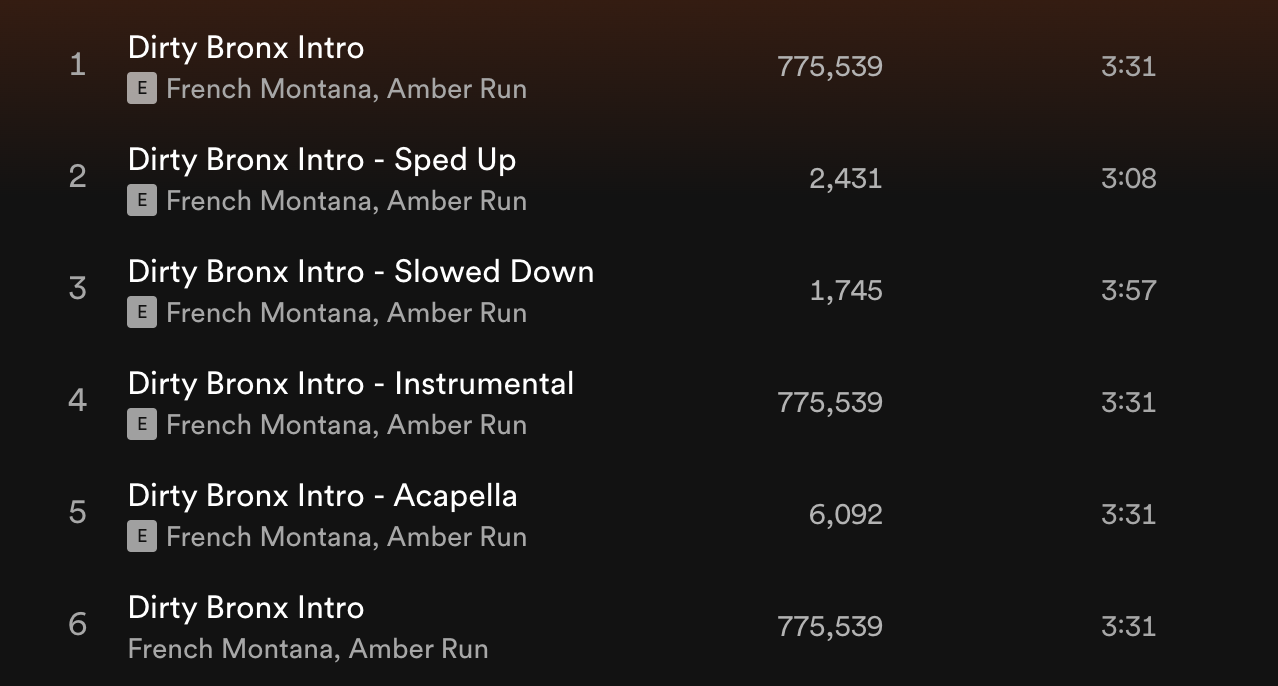
So, in theory, one could click play on the (Versions) rendition of the album, and if you listened in order, you would hear each song in slightly different permutations six times in a row. First the OG version, then sped up, then slowed down, then the instrumental, then acapella, then the clean version. Here’s what that looks like. 

If you’re curious about the Time Math, that means this first three-and-a-half-minute song called “Dirty Bronx Intro” becomes a 21-minute experience when each version is stacked back to back. This all amounts to a 6 hour, two-minute runtime, a duration so gargantuan that the Spotify desktop app rounds down, not even bothering to give an exact time, instead opting to list the album as “about 6 hrs” long. It’s exhausting and amazing.

You know what’s even funnier than French Montana releasing a six-hour album packed with every possible iteration of every song? The fact that French Montana also released each of these one hundred and twenty-six songs as singles. Overnight, his artist page became a genuinely cumbersome experience to navigate, stretching the bounds of what the Spotify engineers ever considered plausible or sensible. 

It’s kind of hilarious to even try scrolling through Montana’s page right now. Especially when you factor in the features listed underneath each song, the whole thing just becomes a disorienting wash of metadata. One Twitter user jokingly asked, “Yo did French Montana drop?” accompanied by a screenshot featuring a 7 by 9 grid of repeating album art. And that’s only half. It’s quite hypnotizing to take in French Montana’s mug that many times, all cast in an identical green-red glow. 

Another Twitter user thought a video might be a more appropriate way to showcase the scope of Mac & Cheese 5 (Versions). They did the only logical thing and made a screen recording showing what it’s like to scroll through the entire thing, taking 18 seconds to reach the bottom.

One brave poster with the handle @Keegan59992745 took it upon himself to listen to the entire thing, leaving followers a harrowing message at the onset of his adventure, posting “See you guys in 6 hours and 2 minutes” along with a screenshot of the album page for context. Later that day, Keegan followed up, explaining that after seven hours (he had to take a break to eat), that was enough French Montana for the rest of his life. Montana may have gotten his 126 streams, but at what cost?

In general, people on Hip-hop Twitter and various message boards were quick to clown on this practice of turning a mid mixtape into something the length of a day shift or multiple Lord of the Rings movies. “All of this just to sell 43k first week,” snarked one person on Twitter. The top comment on the /r/hiphopheads thread for the album bluntly assesses, “This is so embarrassing 🤦.” Further down the same comment thread, one Redditor recognized Montana’s craven and transparent ploy for streams and hoped Spotify would take notice, stating, “That’s insane. This has to be a wake up call for something to change with streaming services. I had to see it for myself and it just ruined my night.

Elsewhere, people were eager to point out how poorly this six-version format fits some songs. Maybe mankind wasn’t meant to hear an acapella version of French Montana’s trademarked “HAAAN” with such clarity. Others were quick to point out the absurdity of having this wealth of options available for something as inconsequential as a mid-album skit. It’s hard to look at “Skit (Sped Up),” “Skit (Slowed Down),” “Skit (Instrumental),” “Skit (Acapella)” and not find it all a little outrageous. 

In fact, let’s take a closer look at the skit on Mac & Cheese 5. Taking place at a train station, we hear 

Montana and an unnamed man reminisce on previous installments of the Mac & Cheese tapes. While the conversation starts centered around Montana and his music, the dialogue quickly devolves into a sexist triage against the unnamed man’s sister. Here’s an excerpt. 

Man, what've you been doin', cuz?
Man, I haven't seen you in about a decade, bro
On the Lamb' with your sister
Last time I saw you, workin' on that Mac & Cheese 3
Yeah, you know, my sister leaked it
No, she leaked Vol. 4, you fuckin' dummy
Well, she leaks everywhere, anywhere she goes
She leaks like a faucet
Yeah, someone's got to fix that up with a wrench
Last time I seen your sister was the zoo
Yeah?
Yeah, and she was over there bouncin' a ball off her nose
Like a sea lion
Yeah, you know what you call your sister?
What?
Glazed donut

This continues on for about a minute until the insults peter out and make way for the next song, “Too Fun,” featuring Kyle Richh, Jenn Carter, and a hip-hop group that simply goes by the name “41.” Maybe I am too old for this. Of course, if you’re listening to the (Versions) rendition of the album, the skit is followed up by a sped-up and slowed-down version, like toying with the playback speed on a podcast, but also listening to it three times over. 

Then we have what’s possibly the funniest moment on Mac & Cheese (Versions), a song called “Skit - Instrumental,” which is actually closer to a field recording than hip-hop. The track is an 87-second-long swirl of ambient noise, interspersed with light background murmurs and the sounds of a distant train car. This is all punctuated by a solitary laugh at the very end, and it’s nothing short of haunting. Brian Eno could never.

Six years ago for Vulture, Craig Jenkins described Migos’ Culture II as a “data dump,” pointing out that the album’s quality did not justify its nearly two-hour runtime. In that article, Jenkins claims that the 24-track Migos record felt like “the first deliberate artifact of Billboard chart gamesmanship” simply because it was packed with so many songs that it felt too unwieldy to even view as an album in the traditional sense. I agreed with him to some degree, but I also kinda took issue with that article at the time, arguing that Culture II wasn’t meant to be listened to all the way through or digested in any traditional way. Sure, it was a lot of content with very little quality control (wink wink, nudge nudge), but the way that most people were using this album negated any claims of data dumpage. At least they were all songs. French Montana must have seen people calling Culture II a data dump and thought, “I haven’t even begun to dump.”

One year ago, I got really interested in the “meta” of the music industry. I wrote at length about Spotify’s AI-generated playlists, TikTok’s influence on streaming and the phenomena of sped-up songs, and even the lack of visibility we have as fans when a song gets yanked offline for arbitrary reasons. Also around this time, I also wrote a piece called “Everything’s a Single Now,” in which I detail my experience stumbling upon Trippie Redd playing this same game of releasing every song off an album as a standalone single. In that case, Trippie Redd released a 25-track album called MANSION MUSIK and also released each of those songs a dedicated single. In that article, I also mentioned Coke Boys 6, a 29-song tape from French Montana and associates that indulged in the same practice. 

At the time, I was mainly writing about those techniques out of morbid curiosity. I wanted to document this objectively goofy practice as it stood in early 2023 because I’d never seen anything quite like it. I never would have dreamt that one year later, Montana would be doing the same thing five times over. 

So I must ask, where does it end? In 2025, will we get a French Montana album with ten versions? One album-length collection of just the bass? A version with just the adlibs? What about a slowed-down clean version? How about a sped-up acapella version with a touch of reverb? Where does it all end? I don’t have the answers, but with French Montana as our fearless leader, I’m excited to continue exploring the bounds of acceptable runtimes until the servers of Spotify overload and DJ Khaled needs to get involved

French Montana, never stop. You are a pioneer and a trailblazer. I will follow you to the ends of the earth until you release an album that lasts years. Hell, why not drop an album that could take me to the end of my life? I’d gladly spend the rest of my days with you, just give me that sweet time-filling Spotify link and let me drift off into the void. I’m ready.

Heart to Gold – “Can’t Feel Me” | Single Review

Memory Music

Some of the best music is seasonal. I’m not talking about holiday music, and I’m not even talking about something overt, like Vivaldi’s Four Seasons. I mean, there are some songs, bands, and sounds that just feel like they suit a certain kind of weather. There are songs for winter that feel nostalgic and heavy and sad, music made for that moment when the sun barely crests the horizon and the temperature seems like it never rises. Then there are songs for summer, which are often eager and full of anticipation, like the feeling of waking up early to take a trip with nothing more than the open road ahead. “Can’t Feel Me” by Heart to Gold falls somewhere between spring and summer, heady with the first warmth of May, yet still tinged with the chill of old snow that lingers in the shadows of the woods.

Heart to Gold has long been a band in my personal rotation of favorites, with their 2022 album Tom being one I still put on regularly. Since the release of their first EP in 2016, their bold sound and distinct vocals have set them apart from other bands in the emo/punk scene, with tracks like “Tokyo” and “Tigers Jaw” only solidifying their position. “Can’t Feel Me” comes on the heels of their 2023 tour supporting scene giant Movements, along with Mannequin Pussy and Softcult. This is also the first we’ve heard from the band since the release of their standalone 2023 single “Chloë,” which was one of my favorite tracks of last year. Heart to Gold consistently outdo themselves with each subsequent release, and “Can’t Feel Me” is no different.

Tender guitars and soaring vocals took me by the hand and pulled me, laughing, through breezy patches of sunlight and past damp, mossy shadows. I felt like I was missing something I never had as Grant poured his heart out over rich chords.

Sometimes the highest highs, at times the lowest lows.
It must feel like I’m distant, constantly can’t feel me.
Seems like the right direction, but right now I can’t see.

His lyrics echo the sentiment so many of us twenty- and thirty-somethings feel. I think this is the right thing to do, but what if I’m making a mistake? Am I doing it right? We are watching the spring of our lives transition into summer, welcoming the change of seasons with open arms and a hesitant smile, but in the back of our heads, we still wonder if it’s where we’re really supposed to be. “Shout it out,” cries Grant, “shout it out! I don’t feel the same!” Neither do I, and as the new warmth of summer touches my skin and freckles my arms, I think I’m okay with that.


Britta Joseph is a musician and artist who, when she isn’t listening to records or deep-diving emo archives on the internet, enjoys writing poetry, reading existential literature, and a good iced matcha. You can find her on Instagram @brittajoes.

Dogs on Shady Lane – The Knife | EP Review

Lauren Records

One of the most comforting things about music, to me, is that there are songs for every possible situation life could throw at you. There are songs for dancing, songs for crying, songs for driving 100 mph down an empty road at 2 am just to feel some intensity. You get what I mean. There’s a bit of Venn Diagram-level overlap in some categories (i.e., you might work out to some of the same songs you party to), but certain genres, sounds, and overall vibes exist at two opposite ends of the emotional spectrum. You’re not gonna put on Joni Mitchell’s Blue while getting ready for your wedding, the same way you wouldn’t put on Megan Thee Stallion when you need to wallow. Brooklyn-via-Providence four-piece Dogs on Shady Lane seeks to challenge this thinking with their latest EP, The Knife. Throughout these four songs, the band refuses to be put into any of these reductive categories, pulling from all sections of the Feelings Wheel to create songs that can soundtrack everything from your next rage room to a contemplative winter night by the fireplace. 

What began with Tori Hall in her college dorm room, Dogs on Shady Lane has existed in a multitude of lineups since 2018, finally settling into its current four-piece: Hall alongside Evan Weinstein, Calder Mansfield, and Grace Goss. The group’s breakout single, 2022’s “Cole St.,” explores an all-consuming love set to a breezy, borderline-twee backing, complete with muted horns, faraway claps, and tight vocal harmonies. On that song, Hall promises, “I’ll give you everything I own,” willing to surrender all of her earthly belongings in the name of devotion. On The Knife, Dogs refine their left-of-center indie sound by countering this softness with an intensity and pure grit we’ve not yet seen from the group. As far as I’m concerned, the grungier, the better — shit that makes you want to punch a wall but also think about the meaning of It All. Throughout this EP’s 13 minutes, I can hear influences from classic Washington grunge acts like Nirvana, Soundgarden, and 7 Year Bitch, but also recent shoegaze groups like Pity Sex and Weatherday.

The Knife exists in extremes. The EP looks at love through different lenses: a neglectful partner, the settled-dust post-breakup feeling of emptiness, washed-up guys with goatees, and the near-obsessive feelings of a new romance. It opens with “Knife (Lady),” a back-and-forth rocker that kicks off with fuzzy, jolting guitars, eventually beginning its cycle of intense throws of distortion, giving way to pared-down, gentler, all-around chiller grooves. The song exists somewhere between My Bloody Valentine’s classic shoegaze crunch and Faye Webster’s jazzy interludes. The give-and-take makes it so that you could be giving your best version of a Millennial Head Banger, then ten seconds later want to lay on a plush velvet couch with a nightcap. 

Throughout The Knife, Dogs on Shady Lane take listeners on an exploration of the emotional contradictions we as humans ceaselessly exist in. Many feelings can be true at once, and this is the reality of the human psyche! There is hate in love, sadness in joy, and confusion in certainty. It’s scary, but it’s also kind of wonderful. The band displays this perfectly as a throughline of the EP: the gently sweet verse melody of “Pile of Photos” clashing with swells of aggressive drums and guitar or the waltzy, dreamy, almost ambient breakdown of “Basement” giving way to a brutally fuzzed out jam perfect for exorcising all of your most negative feelings. There’s an erratic back-and-forth to the entire EP that perfectly parallels the highs and lows of emotionally tumultuous relationships. 

Closing track, “18,” is the EP’s purest moment. Initially released in 2020, Hall recorded all the vocals and instruments herself, including supporting harmonies, electric and acoustic guitars. The eerie electric guitar passes that come and go, combined with the miles-away drums, give the track a distant feeling. Coming off the back of the grungy explosion that is the end of “Basement,” “18” provides yet another contradiction for listeners to ponder. Hall’s vocal delivery is akin to the whispery voices of Phoebe Bridgers or Billie Eilish, making the song feel like a secret. The hook, “I’m too old to be crying so much,” caught me off guard and hit my cancer sun and moon right in the jugular upon first listen. Hearing words I’ve said to myself amidst my latest quarter-life crisis breakdown emphatically sung back to me from all angles of my headphones was one of those disorientingly unique feelings of an artist just getting me. Hall’s haunting vocals stuck with me for days after the song ended. I can still hear her in my head as I’m typing this. The Knife revels in contradictions, but Dogs on Shady Lane take listeners on a sonic, lyrical, and emotional journey that reflects the erratic feelings we all have about love. Looking for the perfect blend of grunge, punk, jazz, and folk? Lyrics that feel like they were written specifically for you? The search ends here.


Cassidy is a music writer and cultural researcher currently based in Brooklyn. She loves many things, including but not limited to rabbit holes, Caroline Polachek, blueberry pancakes, her cat Seamus, and adding to her record collection. She is on Twitter @cassidynicolee_, and you can check out more of her writing on Medium