Mitski and the Complications of Modern Fandom

Indie-Pop singer/songwriter Mitski recently embarked on a North American and European tour to promote her sixth studio album Laurel Hell. This is her first tour and album since 2019’s Be The Cowboy, which concluded with Mitski taking some much-deserved time away from the spotlight. Upon release, Laurel Hell received acclaim from music critics, and has done well commercially, charting #1 in both the US Top Alternative Albums and US Top Rock Albums. However, despite the critical praise and commercial success, Laurel Hell has been divisive among fans, which is not uncommon when an artist returns from a hiatus period. The consistent criticisms range from Mitski’s vocal performance sounding “bored” to her songwriting being “trite.” The album also borrows much of its sound from 80s pop hits, which sometimes limits Mitski from committing to the signature dauntlessness that has defined her music up to this point. What sets Mitski apart from her contemporaries in the indie genre is her urgency and ability to channel raw emotions into spellbinding performances. However, the production on this new album makes her delivery feel impersonal and frustrating. 

Beyond the critical scores and fan debates about the composition of the album – there has been quite a bit of discourse surrounding Mitski herself and the way certain fans consume her music. It started with a Twitter thread from Mitski in which she asked that fans refrain from taking videos of the entire set or songs. She said she felt as if she was being “consumed as content” instead of sharing an honest moment with fans. This idea is not a new one – the majority of concerts I’ve been to have a “no phone” policy, in which there are signs in place and aggressive ushers who are more than happy to escort you off the premises if you so much as check the time. The split reaction within the fanbase to this request caused the first in a series of moralistic debates. You were either on Mitski’s side, or you weren’t. The tweets were deleted following an intense weekend of discourse and fan in-fighting.

Mitski’s choice to communicate this sentiment over her management-run Twitter account is unconventional, given that her social presence online is nonexistent. Despite her genuine intention to relay her wishes delicately, it makes sense that the clinical nature of the tweet thread went over the heads of her audience, who have been born and raised in internet culture. Weeks prior, the disconnect between Mitski and her fandom was apparent when she was traveling the press circuit to promote Laurel Hell. In Cracked Magazine’s “Mitski Reacts to Posts About Mitski” video, Mitski reveals how she lives in “blissful ignorance” of what’s happening online while reacting stiffly to Stan Twitter memes about her music. Halfway through the video, she reads a tweet that says: “New Mitski it’s a big day for sad bitches.” Mitski taps her hands on the armrests of her chair and says, “Y’know, the sad girl thing was reductive and tired five years ago, and it still is today.” She pauses to say she appreciates the person who made the tweet, but then follows up by saying: “Let’s retire the sad girl schtick. It’s over.” Retired from Sad, New Career in Business, indeed. 

While this detachment style may allow Mitski to live in 'blissful ignorance,' it doesn't allow for many fans to receive her words with the earnestness she hopes. Mitski appeals to a very online generation, and with the rise of applications like TikTok, where hyper-categorization for oneself is how you appeal to its algorithm (i.e., get views), it is only natural that fans will view her music as a piece of their identity. Mitski asks not to be “consumed” by her fans, but perhaps she needs to come to terms with her life as an entertainer. Mitski’s real name isn’t even Mitski – it’s a stage name, a persona that she embodies as a performer, making entertainment to be consumed. The very nature of a concert relies on the performer to gain monopolized, undivided attention from onlookers. I mean, why else would you be on a stage, a literal platform that elevates you above an audience? 

It’s innate human behavior to connect with art on a level of self-introspection. A defining element of art is that it means different things to different people; everyone consumes art through their own lens, but this isn’t a reality that a subset of fans are willing to accept. Whether they’re a devoted member of the fanbase or not, it seems that everyone is rushing to supply their takes on the situation. However, a collective sentiment has emerged of supporting the artist no matter the circumstance, even if that means turning on others in the fanbase. As if Mitski will personally thank those who protect her image and adhere to her social demands. 

While Mitski wants people not to consume her and reduce her music down to catchphrases, a portion of her fanbase has equated that to other fans disregarding the racial context of her music. This argument is strange to me because the overwhelming majority of Mitski’s music is about, well, love. Falling in love, falling out of love, being in love too much, not being in love enough – you get the idea. The only song explicitly detailing Mitski’s struggles with identity as a person of color is her song “Your Best American Girl.” Perhaps an argument can be made that “Strawberry Blond” is about Mitski’s personal anguish that she is not white enough for the man of her dreams – but then again, Mitski has never publicly said that’s what the song is about. It is not clear how her racial identity or upbringing features in her music. She very well could be singing about alienation, perhaps as a woman, or just as a generalization. Mitski does very little to bring politics, background, and identity as an interwoven factor within her music. This isn’t a criticism – I just find it necessary to address when fans are other-ing each other and gatekeeping, as if only viewing Mitski’s music in relation to her being a person of color isn’t a reduction and exclusion in its own right. 

Whether it’s the desire to control how she is perceived as “sad girl” music or resistance to being recorded while performing, Mitski’s differing attitudes in communicating with her audience showcase her inability to commit to a public persona. Mitski will dish out contempt for her audience regarding how they categorize its lyrical and sonic content, but will approach delivering requests concerning concert etiquette like a kid trying to convince their parents to buy them a dog. In the past, Mitski has demonstrated her fearlessness and conviction. Her obsessive love ballads on Puberty 2 make me think of Nina Simone – this is the artistic height that Mitski is capable of reaching. In my opinion, Be The Cowboy was a step down from her two previous albums, and it’s disheartening to see this trend continue on Laurel Hell. This decline all happening while Mitski publicly conflates her inability to grasp her new life as a performer and entertainer, ultimately failing to define a boundary of what her fans are to her. 

When discussing her song “Nobody” in a Genius Lyric Breakdown video, Mitski explains how the chorus came to her in a real state of anguish, but she thought: “Let me use this pain and exploit it for money.” This, of course, can be perceived with light-heartedness, but it’s difficult not to take it at face value, considering Mitski is currently at the height of her popularity, and her name is equated with producing music to consume when you are in some state of distress. 

Perhaps she is personally tired of the “sad girl schtick,” but Mitski has to decide whether to embrace the description she trademarked or rebel and create a new identity for her music and voice to exist in. You can’t please everyone. If she truly wants fans to abandon labeling themselves in accordance with the themes of her past work, then why would she continue to write songs that have a similar pay-off? What is the difference between “Love Me More(I need you to love me more / Love me more / Love enough to fill me up) and “Lonesome Love (Why am I lonely for a lonesome love?) – Mitski is still indulging in the same self-aggrandizing individualism that was evident in her previous records, so why should the content be treated differently than before?

As an artist, you have to recognize that a great deal of effort is involved in rebranding and creating new material that allows your career and the subsequent music you make to possess a longer lifespan. Meaning, Mitski will have to rise to new heights and challenge her fans' perceptions of her through the design and function of her music. If you give your fans work that feels familiar, then they already have a conditioned response. By supplying your audience fresh and innovative ideas, you are by default requesting that they open their minds to imaginative possibilities; sometimes, you have to just let your music speak for you. 


Kaycie is a high school senior and writer. You can find them on Instagram at @boyishblues.

I Tried Weezify So You Don't Have To

On January 31st, the year of our lord 2022, the infinitely reputable Louder published a reality-shattering sentence onto the internet; Weezer’s Rivers Cuomo has built his own "Spotify-like player" known as Weezify. I read the headline multiple times, ensuring I was interpreting it correctly. I knew all those words, but I’ve never seen them arranged in such a way. Does this really mean what I think it means? 

This news was coming hot on the heels of musical titans like Neil Young and Joni Mitchell pulling their music off Spotify in the wake of the platform actively spreading anti-vaccine information. Elsewhere, Kanye West announced that his proprietary Stem Player hardware would be the only way to listen to his upcoming Donda 2. The music industry was shifting at speeds we’d never seen before. 

Artists are now beginning to realize that the negotiating power lies in their hands. They are the creators; platforms like Spotify and Apple Music are merely leeches that profit off their countless hours of hard work and years of honed craft. Much like the Starbucks workers unionizing and the Kellogg’s employees striking for better pay, we are collectively realizing the power we have in mutual support of each other. The pandemic has taught us many things as a society, but one of the more optimistic takeaways is discovering the strength we have in solidarity. Similarly, artists are clearly unhappy with the bill of goods they had been sold and are rightfully looking for alternatives. It’s time for innovation, true innovation. Enter Weezify. 

The proposition was simple. “Tired of Spotify? Come on over to Weezify.” Weezer frontman Rivers Cuomo tweeted along with links to the Apple App Store, Google Play Store, and his personal website. How could I say no to that? Every day I wake up and listen to the 15-hour Weezer Discography playlist top to bottom; you mean to tell me that I can get this content somewhere else??

While many people (including myself) foolishly thought this was a goof or simply too good to be true, my curiosity got the better of me, and I soon found myself reluctantly clicking the link to the App Store. I stared at the app page for a minute as if I were standing outside the gates of heaven. “Be not afraid,” the icon seemingly whispered to me as I clicked the download button almost without thinking. 


Upon launching Weezify, you’re immediately greeted with a login screen. Still unsure if this was a legitimate app or just something designed to steal my social security information, I sheepishly clicked “Maybe later,” hoping that my fence-sitting response wouldn’t be reported directly to Mr. Cuomo himself. I am a Weezer Believer, but I also grew up in the era of computer viruses and Rickrolls, so I still have to follow my internet street smarts.


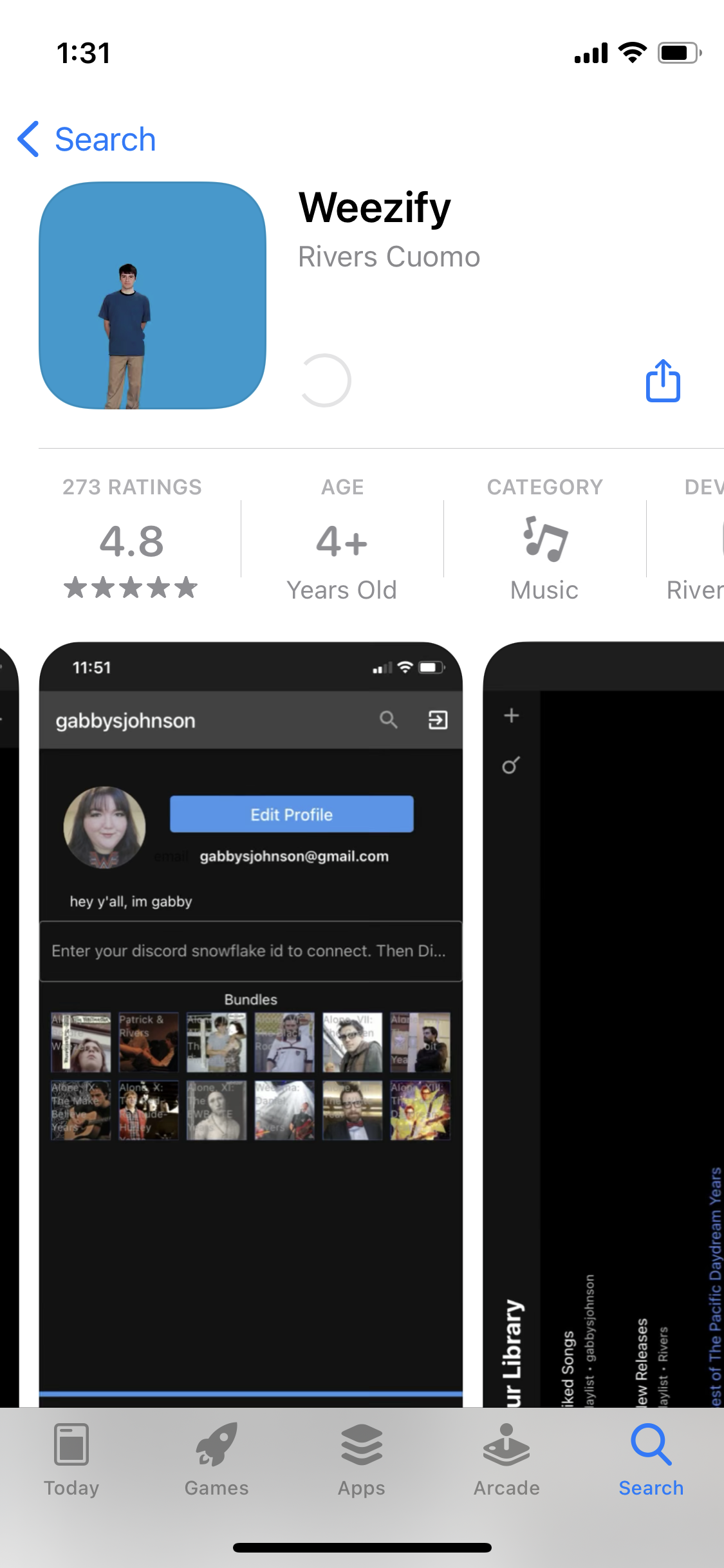
After clearing that screen, the app dumps the user directly into its “Player” tab, which I stared at for a good minute until I soon became crushed when I realized that it wasn’t going to load. A constantly-swirling blue loading icon taunted me, beckoning to the wild treasures that might hide behind it. My mind was racing.

Dismayed but not deterred, I clicked over to the “Profile” tab to work my way through the app left to right. I was informed that I was a “Lurker” as I stared at my profile picture: a Rivers Cuomo Funko Pop which sat perched atop a quote from “Surf Wax America.” Again, the app encouraged me to sign up or log in. Not yet, Rivers, you temptress. 


With the image of the cold, dead eyes of a Rivers Cuomo Pop Fig freshly burned into my mind, I clicked onto the “Market” tab and suddenly found myself face to face with… this.


Rivers Cuomo jump scare.


I howled. I recoiled. I don’t know what I expected to find on this page, but it was not a bowtie-clad Rivers Cuomo selfie staring me down. 

The top of the screen informed me that I own 0 of 12 bundles and 0 of 3236 demos. Three thousand two hundred and thirty-six demos. That’s enough Weezer to gorge yourself. That’s enough Weezer for a lifetime. That’s enough Weezer to bring you to your deathbed. 

I clicked on the selfie almost instinctively. It’s one of those moments where life has led you down a path, and you know what you must do. You can turn tail and run, but some divine being has led you to this moment, and you can decide to either press your thumb down gently upon Rivers Cuomo’s face, or you can deny yourself the experience that life has set out before you. 

A popup appeared with a slightly wider crop of the same photo and a description that reads, “New hope with our singing with Jonathan Daniel. Jake was a big influence.” Below that laid a series of confounding numbers. 

-2
-3
-4
-5
1-4-2-5 @126_2015_3_9_13_9_12
1-5-4
@771I_want_down_time_2015_2_23_17_23
116._one_time_2015_2_25_13_52_22

What is this? Some kind of code? Coordinates? A sleeper agent activation phrase? I was scared. 


Suddenly, audio began to emanate from my phone. I heard a Weezer song being played from a computer as Rivers Cuomo himself harmonized with the tune. Seemingly playing these tracks off of his personal speakers, Rivers clicked through various White Album-era demos and gave some background to the band’s recording process at the time. He rifled through the files, filled with wonder spurred by individual rarities and alternate melodies. It’s the same energy that I have while scrolling through my mp3 library, clicking on a half-dozen different tracks before landing on what I actually want to listen to. The difference here being that this was a man listening to his own songs. He sang along softly at various points before clicking feverishly onto the next file. After shuffling through various White Album oddities for a few unstructured minutes, he sighs, comes back to his senses, and unceremoniously says “alright… bye,” and then the recording ends. 

Slightly disoriented, I soon began to understand; each of these bundles had an “introduction” where Rivers himself gave some contextual background information on the specific era of the band and then encouraged you to purchase. Those numbers, coordinates, and inexplicable characters were individual tracks, all of which contribute to the collective 3-thousand-plus songs contained within the app. Whew. 

Rivers is no stranger to demos; his series of Alone albums from 2007, 2008, and 2011 gave a peek into the band’s early years and Cuomo’s specific creative process. This app is the slightly-illogical continuation of this, with thousands of demos available for Weezer superfans who want to fill every hour of every day with weird slightly-unpolished Weezer recordings unheard by most of the general population. 

With 12 bundles at $9 a pop (and one inexplicably priced at $10), that means you can currently have access to the entirety of the Weezer demo oeuvre for the low, low price of $109. How can one possibly say no to that?

In all seriousness, Weezify is a rough-around-the-edges app built for a bafflingly-small niche group of super fans. Is Weezify the answer to every intricacy of the Streaming Debate? Yes, it is. Will it replace Spotify? Also yes. Will I spend every waking hour of my life listening to things like “TechnoProgressions1 i VII VI iv”? Yes, I will. Thank you, Rivers Cuomo, for the one ethical musical streaming app, nay, company to ever have existed. 

SASAMI – Squeeze | Album Review

My musical DNA was cultivated by the airwaves of Sacramento radio in the late Nineties and early Aughts. The variety wasn’t that much different from today; I had access to alt-rock, hard rock, classic (dad) rock, and whatever the hell adult contemporary is, all of which was available to scan through on my Chrysler Crossfire boombox from The Sharper Image. I was a devout listener to these stations because they gave me access to an ever-expanding catalog of music. My favorite station was the alt-rock haven, KWOD 106.5 FM. KWOD embraced the catch-all term of “alternative,” playing all kinds of genres ranging from goth rock, jangle pop, grunge, alt-metal to ska. Eventually, I got the nerve to plug my headphones into my stereo after my bedtime so I could listen to the late-night programming where the programming became more akin to college radio. Through this radical act of disobedience, I was introduced to “cool” music like Joy Division that alerted me to the fact that there was music beyond what was usually played on air.

When I got to college in 2011, I started listening to the campus radio station, KSMC 89.5 FM. It was here that I dove deeper into music that was actively transgressive of the mainstream. I was listening to local Bay Area bands like Thee Oh Sees and White Fence as I searched for music that I felt could be my own. My taste in music and listening habits have continued to grow over the years, but my early adolescence, when I was largely listening to the radio, will always be the most impactful period in the development of my musical identity.

The recontextualization of grunge and nu metal over the past few years has been a welcome trend to my ears and heart. Not only have I enjoyed immersing myself in the fresh spins provided by bands like Loathe, but I’ve returned home to bands like Soundgarden and System of a Down with a new perspective. These retreads aren’t done as a bit or as a nostalgic soak; instead, it feels like I am coming full circle to the understanding that a lot of that music genuinely kicks ass.

SASAMI’s Squeeze seems to fall in line with this wave of nu metal revivalism, but for me, this album is so much more; it’s a map of my own musical journey. Squeeze is a sharp left turn from the hushed shoegaze found on SASAMI’s debut, trading those soft, sentimental sounds for punchy heavy metal riffs. “Skin A Rat” kickstarts the album with incendiary guitars and drums, the latter courtesy of Dirk Verbeuren from Megadeth, complemented by harsh distorted vocals where SASAMI sings about crushing you under her big boot. “Say It” brings to mind the arena-sized industrial bravado of Nine Inch Nails, and it’s clear that she understands that what makes Trent Reznor a great artist is that underneath all of the noise and theatricality, he’s a melodic savant. The opening riff on the Daniel Johnston cover “Sorry Entertainer” is reminiscent of Weezer’s “Hash Pipe,” but infinitely heavier. SASAMI isn’t just paying homage to metal; she’s bending it to her will to create something that is unique to herself.

This attack of the senses dates all the way back to 2020 when SASAMI released a cover of System of a Down’s “Toxicity.” While her rendition is an acoustic interpretation, SASAMI was tipping her hand to her influences before unveiling her master plan. When she released “Sorry Entertainer” as a single in July of 2021, there was no mistaking the depths of her musical DNA.

But SASAMI isn't just making a metal album with Squeeze; in a stroke of brilliance, she has juxtaposed the snarling vitriol of songs like “Skin A Rat” with a stunning collection of radio-friendly pop songs and ballads. “The Greatest” is a pained love song with a massive chorus that begs to be played to a crowd of thousands. “Call Me Home” and “Tried To Understand” both call to mind the unimpeachable badass Sheryl Crow as SASAMI dissects American ideals of careerism and masculinity. Not only does she sing about some similar themes as Crow, but SASAMI’s voice and delivery feel like direct descendants of one of America’s great artists in the best way. Album closer “Not A Love Song” is a colossal ballad that pulls from SASAMI’s past shoegaze aesthetics as guitars screech and swirl behind her lyrics of attempting to express her feelings to a loved one.

Something fun about Squeeze is that it’s an album that rewards those who are fans of reading the liner notes. There are so many talented people who helped make SASAMI’s vision a reality. Artists like King Tuff, Hand Habits, Vagabon, Mitski, Ty Segall, Patti Harrison, and the aforementioned Dirk Verbeuren are just a handful of musicians who contributed to this record. Personally, I get a kick out of seeing so many people collaborating seamlessly on a project that feels so different from what they are most known for. Beyond that collaborative spirit, it's thrilling to see these artists treating this style of music that I grew up on with such genuine reverence. It goes to show how deep this appreciation goes for all of us. But despite the exciting list of musicians who helped, this is still SASAMI’s show. 

I think what I love most about the album is its refusal to be quiet. Everything is so loud and emphatic as SASAMI is taking charge, almost as if she’s peeling your eyelids back and forcing you to bear witness to her raw power. The heavy songs are nasty and brutal, but it's the pop songs that benefit most from this shift in philosophy as they pull from the in-your-face energy of metal to ensure that you hear SASAMI loud and clear. While these songs might not bear the sonic trademarks of metal, they are infused with an emotional heaviness that hits you harder than any riff can.

Squeeze is a chaotic album that feels all over the place as SASAMI shifts between styles, but have no fear; she is in full control. When I listen to the album, I feel like I’m back in my childhood bedroom traversing the airwaves on my Crossfire boombox. I’m in a space of discovery, and SASAMI is my guide.


Connor lives in San Francisco with his partner and their cat and dog, Toni and Hachi. Connor is a student at San Francisco State University and is working toward becoming a community college professor. When he isn’t listening to music or writing about killer riffs, Connor is obsessing over coffee and sandwiches.

Follow him on Twitter or Instagram.

I AM GOING TO TAKE THIS A LITTLE WHILE LONGER: 20 YEARS OF ALL HAIL WEST TEXAS

It is beautiful, sure, but a lot of it is empty. Empty in a way that feels heavy, like the big cities in Texas are just fronts to hide that most of it’s an empty state, with a population trying to be as loud as possible so no one will notice that all of them live tucked away in the east. All Hail West Texas, right? I mean, most of this could be said about America as a whole, but I’m not in America right now– I’m in Texas.

(Keisha, narrator of Alice Isn’t Dead)

I have never been to West Texas, or to anywhere in the American Southwest for that matter, but I’ve often entertained fantasies of escaping to some quiet, near-empty place in the desert. Mitski songs aside, Texas is not a landlocked state. But the vast flatlands seem as infinite as the stars above them, making it easy for one to fall for such geographic optical illusions. These are, as Darnielle described on an episode of I Only Listen To The Mountain Goats, “places where you’re alone with yourself.” In my fictional West Texas, my closest neighbors would be miles away, but my home would be open to a revolving door crew of lonely drifters and passers-through, not unlike the ones in Color In Your Cheeks:

They came in by the dozens, walking or crawling
Some were bright-eyed, some were dead on their feet
But they came from Zimbabwe or from Soviet Georgia
East St. Louis, or from Paris, or they lived across the street
But they came, and when they finally made it here
It was the least that we could do to make our welcome clear

It’s a fantasy defined by solitude, but in such a way that somehow– much like The Mountain Goats’ music –makes me feel less alone. Part of my love for All Hail West Texas lies in this contradiction and keeps me coming back to a central question: How can an album that evokes such emptiness and isolation simultaneously be a deeply powerful celebration of community and human connection?

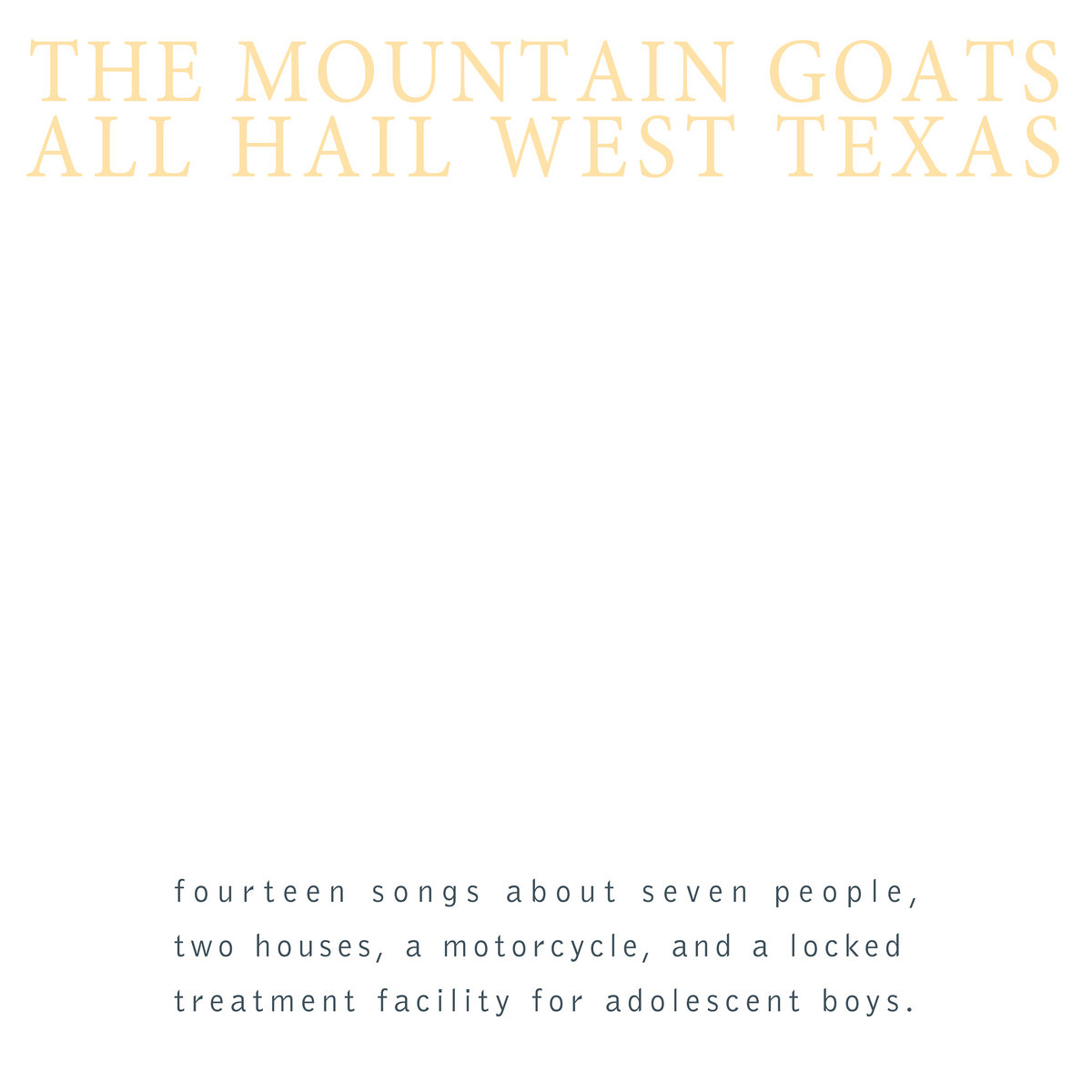
Like all of my most beloved Mountain Goats albums, All Hail West Texas feels like a collection of overlapping short stories. As its indicatively minimalist album cover promises, it is “fourteen songs about seven people, two houses, a motorcycle, and a locked treatment facility for adolescent boys.” You won’t hear Darnielle giving a breakdown of these seven characters in interviews or definitively saying which songs each one of them is featured in. Some are mentioned by name: Jeff and Cyrus, the two members of the titular Best Ever Death Metal Band In Denton; William Stanaforth Donahue, a 17-year-old ex-running back who gets a federal prison sentence for selling acid after an injury ends his football career; Jenny, a recurring character in The Mountain Goats’ discography who’s seen tearing through the desert on a Kawasaki motorcycle. Other characters are left more ambiguous: somebody who drives two hours to Austin every week just to retrieve postcards from a former friend or lover; Jenny’s admirer whose infatuation prompts him to hop on the back of her motorcycle and ride off into the sunset; a hard-spending and even harder-drinking couple who refuse to part ways no matter how miserable they make each other (some have speculated that these two might be the Alpha Couple, the subjects of the following Mountain Goats album). Darnielle’s storytelling is non-linear, and the information he withholds is as crucial as what is revealed. Recognizable plot points are scattered across a sonic landscape that feels as wide and as empty as West Texas itself. 

As we celebrate its 20th anniversary, it feels necessary to highlight the timing of this album. It marks an important turning point in the band’s history as the last album of the fanbase-splitting “lo-fi era.” Production-wise, it was the swan song of Darnielle’s Panasonic RX-FT500 before the long-suffering machine broke down for good. Though most of my favorite Mountain Goats albums are from 2002 onward, my ears perked up upon hearing the return of that familiar tape hiss crackling through 2020’s Songs For Pierre Chuvin

It’s also worth noting that All Hail West Texas was the first Mountain Goats album released after 9/11. In some ways, it feels like an unintentional post-9/11 cousin to Lift To Experience’s 2001 cult classic The Texas-Jerusalem Crossroads– a sprawling post-rock concept album about the second coming of Christ set in Bush-era Texas. Darnielle’s values– religious, political, philosophical –are made clear throughout his discography, despite his general aversion to stating them overtly. Even though it lacks direct references to specific political stances or issues, All Hail West Texas is arguably the most political Mountain Goats album. The closest thing to a protest song Darnielle has ever written, “Fall of the Star High School Running Back,” tells the tale of a teenage victim of mandatory minimum sentencing. The narrator of “Pink and Blue” lacks adequate resources to care for their new child who’s been abandoned by a birth parent with even less. In the wake of 9/11 and subsequent racist and xenophobic backlash, “Color In Your Cheeks” takes on an additional layer of political significance. It’s a song about the true meaning of “southern hospitality”-- about sanctuary, about community, about opening homes and hearts to those seeking refuge and telling them “you are welcome here.” During its episode of the aforementioned podcast, Darnielle emphasized the importance of the song’s first-person plural perspective: “There’s no ‘me and you;’ it’s ‘us and y’all.’”

Like much of The Mountain Goats’ catalog, the songs on All Hail West Texas recognize that ‘home’ is a multifaceted, often tenuous thing. Pockets of refuge almost always stand on a precarious foundation. The safe havens provided in “Color In Your Cheeks” and “Pink and Blue” are makeshift ones, implied to be temporary. Teenagers Jeff and Cyrus find a home in their shared passion for death metal– a passion also shared by Darnielle himself –but are separated from their music and from each other by disapproving adults. In “Jeff Davis County Blues,” a man who’s just spent three nights in jail “dream[s] about home” while driving, but it’s unclear whether he even has a home to return to. “Riches and Wonders'' chronicles the slow death of a dysfunctional relationship punctuated by sporadic moments of genuine affection, summed up by a simple yet crushing line: “I wanna go home, but I am home.” It’s a fan favorite Darniellism, one that reads like the devastating flip side of Talking Heads’ loving declaration: “home is where I want to be, but I guess I’m already there.” 

If you were to make a Venn diagram of fans of the Mountain Goats and people with a complicated relationship to the concept of home, you might as well draw a circle. Though all of us have unique personal connections to the band, one of the constants among Mountain Goats fans is that each one of us has, in some way, found a home in their music, however fleeting that may be. 

The first time I saw The Mountain Goats live was almost four years ago, during my sophomore year of college. It had been a tumultuous spring semester, to say the least. I’d gotten caught up in my friends’ infighting and said things I regretted in an attempt to protect the reputation of someone who didn’t deserve my loyalty. I felt as though all my peers had found some sense of academic and professional direction that I couldn’t seem to attain. My childhood cat had recently been put down while I was away at school and unable to properly say goodbye. I was just starting to process traumas that I’d spent months, even years repressing, believing that if I pretended hard enough that these things hadn’t happened, it would eventually become the truth. 

For a couple of hours, a venue located inconspicuously in an Upstate New York strip mall became a sanctuary. With the second encore came a moment I’ll never forget. During a slowed-down rendition of Transcendental Youth’s penultimate track, “Spent Gladiator 2,” I locked eyes with John Darnielle from the back of the darkened concert hall as he sang the words, “just stay alive/stay forever alive.” His words have stayed with me ever since, their meaning evolving alongside my own growth. Sometimes it’s a command, sometimes a mantra. Sometimes a plea, sometimes a prayer. Whatever shape it takes, it’s a promise I’ve made to John and to myself. 

At its core, All Hail West Texas– and The Mountain Goats’ music as a whole –is about staying alive. John Darnielle’s characters are flawed, but what makes him such a compelling storyteller is that he doesn’t judge them for trying to survive. These are songs about doing the best you can with what you have. Darnielle isn’t here to show us the way out of whatever darkness is plaguing us, but he can remind us that a way out exists. 

Absolute Lithops Effect” ends the album on a quietly hopeful note. It’s in good company with some of my other favorite album closers in which “night comes to Texas” (including one from The Mountain Goats’ 1997 album Full Force Galesburg). When Darnielle sings, “I’m going to find the exit,” it isn’t boastful or even declarative, but it’s life-affirming in its simplicity. He might not be able to offer us a sure solution, but he gives us what he can: “a little bit of water, and a little bit of sunlight, and a little bit of tender mercy.” Our narrator– alive but still hurting –describes the “tiny steps forward” that he is taking: “I will bloom, here in my room.” Later in the song, we see him emerging from said room and telling us: “I will go to the house of a friend I know/and I will let myself forget.” It’s something of a cyclical album– starting with two friends being torn apart from one another and ending with two friends reconnecting. In both songs, statements of perseverance cut through the characters’ suffering:

When you punish a person for dreaming his dream
Don’t expect him to thank or forgive you
The best ever death metal band out of Denton
Will in time both outpace and outlive you
Hail Satan!

Darnielle has called this song a hymn, which, understandably may confuse some due to the “Hail Satan” of it all. But it is, by definition, a song of praise, of giving oneself over to a higher power– in this case, the almighty power of death metal, self-expression, and adolescent rebellion. Through adversity there is victory, even when victory just means living another day. “Hail Satan” is more than just a silly reference to the boys’ transgressive rockstar personas (complete with pentagrams and edgy, already-taken band names). “It’s a celebration of two people being true to themselves,” Darnielle has explained, “It’s a celebration of the later Satanic principle of self-knowledge, which isn’t really Satan at all– it’s actually godlike.” By saying “Hail Satan,” what Jeff and Cyrus are really saying is “Hail Us.”

Last fall, I went to my second Mountain Goats concert and was lucky enough to hear this song live. It was a solo show, just John and his guitar and a room full of people singing along, our “Hail Satan!”s echoing off the high ceilings. I thanked whatever God I may or may not believe in that I’d taken John’s advice and stayed forever alive. I was not what I used to be. All Hail Satan, All Hail West Texas, All Hail Us. 

STAY WHEREVER THE HELL YOU ARE. TAKE THE TRAIN DOWN HERE IF YOU GET A CHANCE. DRIVE OUT TO THE AIRPORT. YOU CAN’T MAKE ME LEAVE. I LOVED YOU. I LOVE YOU. THERE ARE NO WINDOWS OR DOORS AND THE WALLS ARE ON FIRE. YOU CAN GET OUT IF YOU’RE COMMITTED TO THE EFFORT. IT’S EASY TO GET OUT IF YOU BELIEVE IN YOURSELF. YOU HAVE REALLY LET YOURSELF GO. YOU ARE NOT WHAT YOU USED TO BE. YOU ARE LOVELY BEYOND COMPARE, BEYOND COMPARE, BEYOND COMPARE. WE HAVE NO HOUSE. OUR HOUSE WOULD BE A LOVELY SOUTHWESTERN RANCH HOUSE. OUR HOUSE WOULD BE A LOVELY SOUTHWESTERN RANCH IF IT HAD A ROOF. OUR HOUSE IS A LOVELY SOUTHWESTERN RANCH. I’LL TAKE AS MUCH OF THIS AS I CAN POSSIBLY BEAR. I AM GOING TO TAKE THIS A LITTLE WHILE LONGER. I AM NOT GOING TO TAKE THIS ANYMORE. 

(Excerpt from the liner notes of the 10th-anniversary reissue)


Grace Robins-Somerville is a writer from Brooklyn, New York. You can find her on Instagram and Twitter @grace_roso.

Cry On, Space Cowboy: Cloakroom's 'Doubts' Sings the Sorrows

Have you ever heard a song so affective that it ruined a band for you? It’s the sort of song that infiltrates every fiber of your being and sinks its claws deep into your soul. It becomes a fascination as you play it on repeat or skip straight to it. You feel that the song was made only for you. Anything else from the artist, no matter the quality, is rendered meaningless because you have this one song, and for you, that is enough.

I have this relationship with Cloakroom’s “Doubts.” The penultimate track from the Indiana stonergazers new album Dissolution Wave leaves me breathless with each lesson. It’s a relatively simple song, four short verses, a couple of short breaks, and a gentle guitar solo that plays as the music drifts to a close, but it’s how the band puts it all together that makes “Doubts” so special. Cloakroom are masters of texture, and they put their skills on display here. Negative space is filled with pristine guitar chords, and while infrequent, each strum is purposeful and emotive. A low, purring bassline provides warmth as a patient drum pattern crackles in the background. All of this is befitting of the album’s space-western concept as Doyle Martin’s lyrics feel like the slow-moving thoughts of an astronaut floating away in the ever-expanding universe.

I find the song chilling, and I believe it is the most beautiful thing Cloakroom has recorded. Maybe I’m too close-minded, but I don’t need anything else from the group. That’s not to say that I don’t think their bone-crushing riffs don’t do it for me, but when I put on “Doubts,” there’s nowhere else in the world I’d rather be than in those four minutes.

As I realized that I kept returning to the song, I tried to puzzle out why. Each time I listened, I found myself getting hung up on this brief guitar motif trying to think of what it reminded me of. After a week of it looping in my head, I realized that it’s reminiscent of a melody in “Goddamn Lonely Love” by Drive-By Truckers, a song with which I have a similar relationship. Now, I’m accusing Cloakroom of being copycats, but I can’t unhear what I’ve heard. In fact, I’m thankful for this great-minds-think-alike moment because the two songs have so much in common beyond some short melodies.

Like “Doubts,” “Goddamn Lonely Love” is a wistful yet gorgeous tune. Jason Isbell might sing his blues with more gusto than Martin, but both are blue nonetheless. These songs traffic in sorrow and regret more than they do in outright pain and misery. Upon this revelation, it became clear to me that much like “Goddamn Lonely Love,” “Doubts” is tears-in-your-beer music. It’s the kind of song destined to play over the speakers of a gloomy bar while a sad cowboy huddles over his third round of a beer and a shot combo. This, my friends, is very much my shit. While I may be just another city boy, I routinely find myself sympathizing with depressed plains walkers. Like these melancholic rancheros, I am not inclined to divulge my feelings. Healthy or not, I know I can always find solace in the company of songs like these.

I have no idea if Cloakroom intended to link themselves to crestfallen troubadours such as Isbell, Jason Molina, and the unimpeachably dolorous Townes Van Zandt, but this style of music fits them so well. They’ve hinted at their appreciation of this brand of song with covers of Songs: Ohia and Tom Petty, but this feels like their first true foray into downtrodden cowpoke-dom. Their interpretation of the tradition is earnest and done without pastiche. With “Doubts,” the band has hit upon something timeless, which is why I can, and will, listen to it forever.


Connor lives in San Francisco with his partner and their cat and dog, Toni and Hachi. Connor is a student at San Francisco State University and is working toward becoming a community college professor. When he isn’t listening to music or writing about killer riffs, Connor is obsessing over coffee and sandwiches.

Follow him on Twitter or Instagram.