Twin Fantasy (Taylor's Version): The Toledo-Swift Parallel Theory
/On the surface, Taylor Swift and Will Toledo might feel like very different musicians, but they actually have more in common than you might expect
Read MoreOn the surface, Taylor Swift and Will Toledo might feel like very different musicians, but they actually have more in common than you might expect
Read More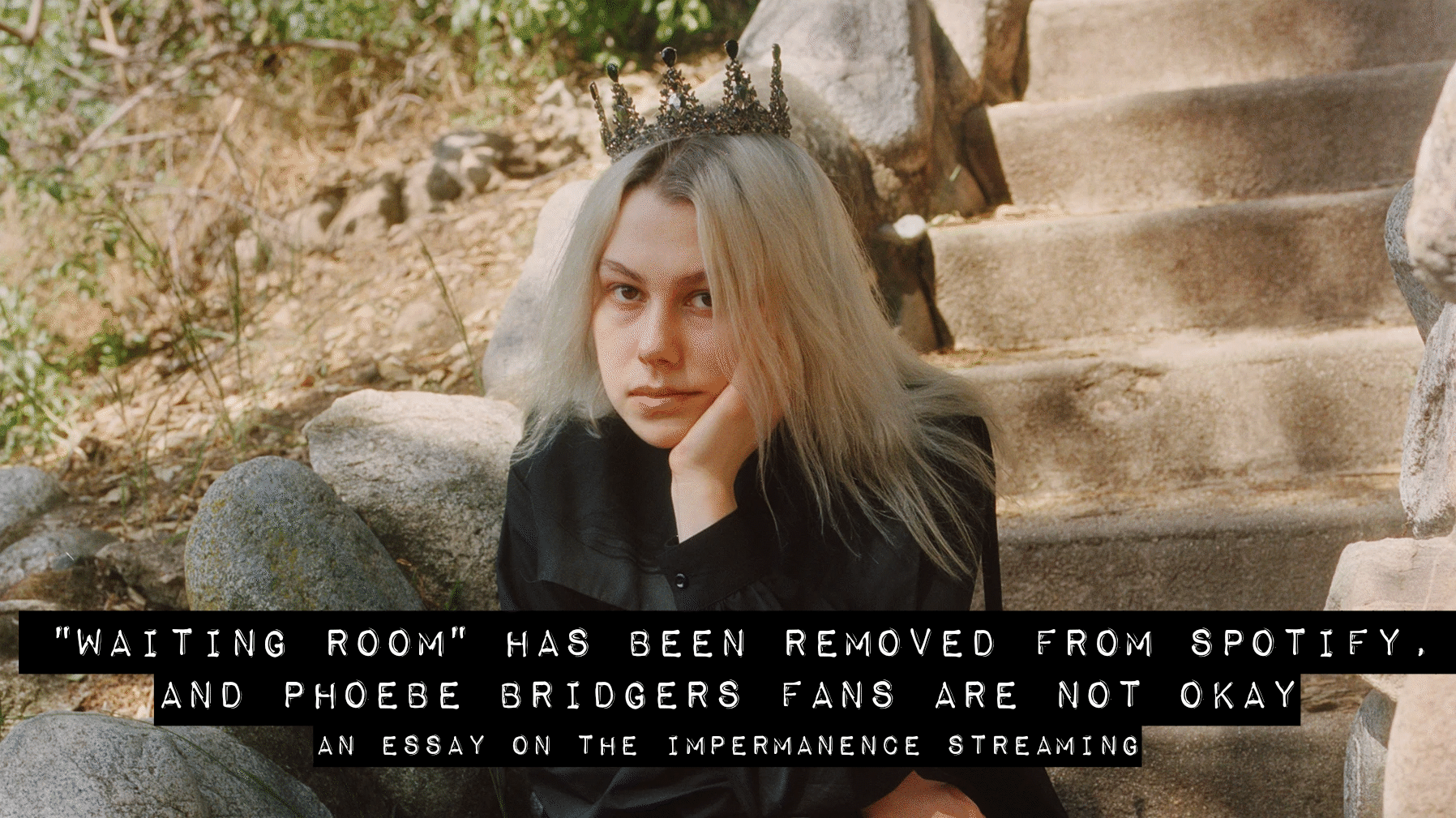
“Waiting Room” by Phoebe Bridgers is no longer available on Spotify, and that should worry everyone. The six-and-a-half-minute gut-wrencher wasn’t on any of Phoebe’s core studio albums, EPs, or various side projects but appeared instead on a 2015 compilation put together by Lost Ark Studios.
Having been released five years prior to Punisher (aka before Phoebe Bridgers became Phoebe Bridgers) and on a relatively obscure comp, “Waiting Room” was a hidden gem in Phoebe’s discography. The track was a diamond in the rough, waiting to reward those willing to dig around for it. Now it’s gone.
We have no idea whether the song is off Spotify because of some random copyright nonsense, a license renewal lapse, or something else entirely. All fans know is that they can’t easily listen to one of their favorite Phoebe tracks.
If I were to guess, I don’t think Phoebe or her crew even assumed people would notice if this song disappeared. In fact, they might not have even known. The track had over 24 million streams on Spotify but was buried so deep under other, more popular releases they probably didn’t foresee any outcry to this song being yanked off streaming. But outcry there was.
‘waiting room’ is no longer on spotify. pic.twitter.com/1sy0Qj6XQ0
— phoebe daily (@sourcebridgers) January 24, 2023
One of the first warning shots came from “phoebe daily,” a Phoebe Bridgers fan account on Twitter with over 15k followers. On Tuesday, the account tweeted in all lowercase, “‘waiting room’ is no longer on spotify,” with as much pseudo-journalistic authority as a fan account can muster. The tweet quickly garnered thousands of likes and shocked quote tweets.
“This is literally the worst thing that’s ever happened in my life, and I watched my dad die when I was 17,” tweeted one distraught fan. Elsewhere, people used humor to soften the blow. Some users held mock funerals for the song, while others reminded people to be kind to their gay friends and the hot girls in their lives because they would be in mourning. It was collective group therapy at its finest and the kind of reaction that feels hilariously on-brand for Phoebe’s fanbase. People were truly Going Through It.
what the fuck pic.twitter.com/L7BB5g9CrL
— matt (@mattxiv) January 25, 2023
As word spread through Twitter, Reddit, and TikTok, one question was being asked consistently: why? Why this song? Why now? Why would Phoebe do this to me? The frustrating thing is we don’t know.
While some guessed it might be a copyright issue, others noticed that Lost Ark Studios (the recording studio that put together the release) was labeled as “temporarily closed” on Google and reasoned that they might have gone out of business. No money means no more paying to keep your songs up on streaming.
An optimistic fan hoped that maybe this meant Phoebe was recording a new version of “Waiting Room.” This is a nice theory, especially in the wake of the return of Boygenius, but in the following sentence, the same person also speculated that Phoebe herself doesn’t resonate with that song anymore given how old it is. That’s a common phenomenon that many artists have with their early work, especially those who rise to success as astronomically as Phoebe. In any case, we still are left guessing, and that puts everyone in a similar frustrated position.
@nolanrussellmusic phoebe put it back NOW #fyp #fypシ #phoebebridgers #waitingroom #music #spotify ♬ original sound - <3
Whether or not you count yourself among the ranks of Phoebe fans lamenting the loss of their favorite under-the-radar deep cut, this news is symptomatic of a bigger problem with streaming services. Spotify ain’t free. It isn’t free to use as a listener, it isn’t free to run as a company, and it isn’t free for the bands who upload their music to the service.
As I’ve written about before, this could all go away at any moment. Spotify could go under tomorrow, and you’d lose everything: your songs, your playlists, and every single artist you follow. The same thing goes for Apple Music, TIDAL, or any other digital-based streaming subscription service.
Even if the company didn’t go bankrupt (admittedly a far-flung catastrophic scenario), there are other ways you could still lose access to your library. Stop paying for your monthly account? You better have a backup plan. Spotify’s servers go down (as they did earlier this month)? Good luck listening to your music. Violate Spotify’s terms of service? Kiss your profile goodbye.
My point is there are a million different ways you could lose access to your music library, and for a person like me who spends countless hours/weeks/months of their life building these intricate webs of musical obsession, that’s terrifying.
This is why seeing “Waiting Room” going away is such a shock; it feels like a violation of our personal music library. Removing the ability to hear a song just flat-out sucks, no matter how you cut it. The second kick in the ass came when Lost Ark also removed the track from their Bandcamp page, essentially eliminating any easy (or legal) way to obtain an MP3 copy of the song. Fuck that.
Things like this are why I have a safety net. I know sometimes I probably sound like a physical media doomsday prepper, but the whole “Waiting Room” fiasco should act as a reminder to save the things we love. It’s a reminder that preservation is important. It’s not like this song is gone forever, but it sure is gonna be a hell of a lot harder to hear now. And who knows? Maybe “Waiting Room” will be re-uploaded to streaming in a few days, and it will be like none of this ever happened. But maybe it won't.
Even still, I hope this instance inspires at least a few people to start offline music collections. Download a bunch of MP3s to your computer, back them up on a hard drive (or two) and keep them safe. We can only trust artists, labels, and companies to be stewards of their work to a certain point. Sometimes it’s best to assume that if you’re not backing something up, then no one is.
In the case of “Waiting Room,” Phoebe is a big enough artist that this track will live on through file sharing, Youtube uploads, and live performances until the end of time, but she’s the exception to the rule. All of this could go away at any time and for any reason, so preserve what you love, back it up, share it, and treat it with the reverence that it deserves. Most importantly, as with all art, love and appreciate it while you can.
Some artists are releasing entire albums as singles now and clogging up streaming services as a result.
Read More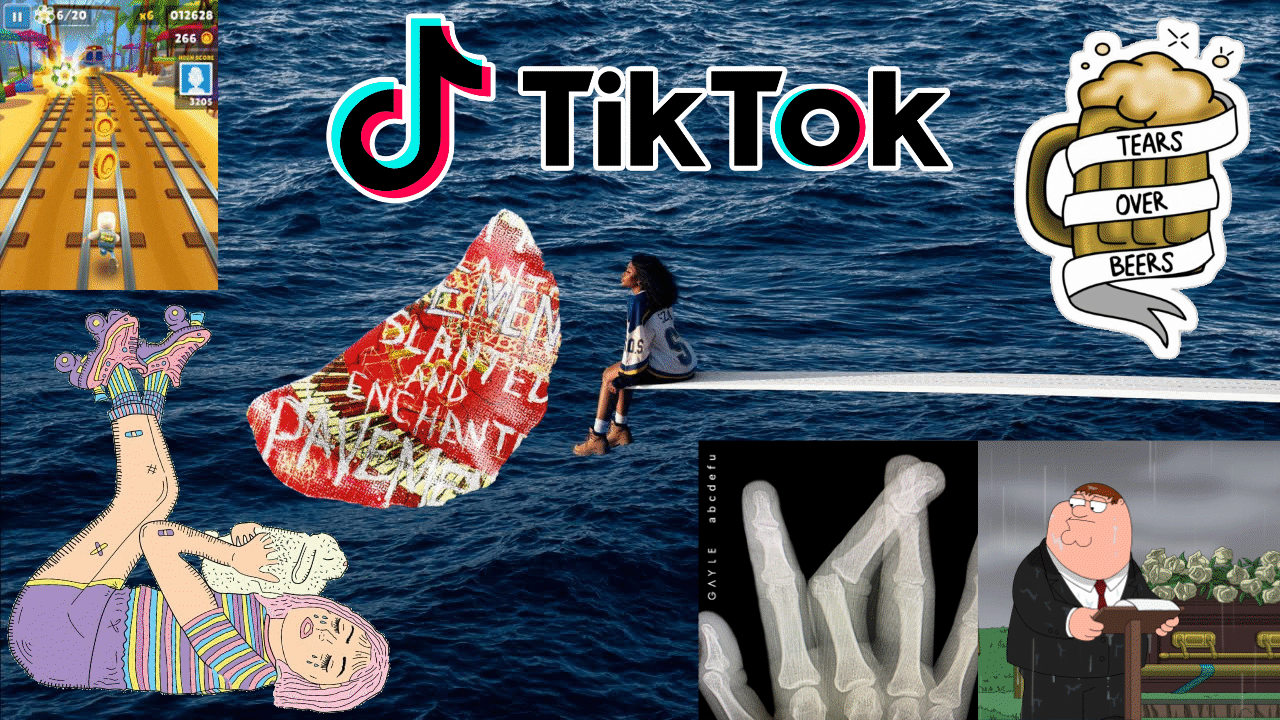
Let’s talk about TikTok.
The video-based social media app launched in 2016 but grew explosively and unexpectedly during 2020 when none of us had anything better to do than stay inside and stare at our phones. As social media networks tend to do, TikTok went from a semi-niche video repository to a necessity almost overnight. Brands flocked to the platform peddling their wares, influencers made accounts hoping to be the next social media star, and creatives begrudgingly scooped up their @’s on the off chance that their promotional efforts paid off.
Over the course of the last five years, TikTok has had an increasingly influential hand in the music industry and culture at large. The platform was initially designed around music, specifically goofy mouth-alongs and a unique duet feature called “stitching,” which relied on a split-screen retweet-type feature between two different accounts. If you’re on the app, none of this is revelatory, I just need to give some background info for anyone over 25 who happens to click on this article.
Over time, TikTok became less focused on music and now hosts a wide range of content on everything from cooking instructionals and comedy skits to whatever the hell this is. There are a few people dedicated to documenting the unique brand of insanity happening on TikTok (shoutout to @coldhealing on Twitter), but that’s mostly a discussion for another day. As with any social media platform, some of it’s good, some of it’s bad, and some of it is actively smothering your brain cells in a wash of flashy colors and vaguely horny brain rot.
This is what your little cousin watches 14 hours a day pic.twitter.com/gMkByHrTes
— very tall bart (@TallBart) January 7, 2023
But this is a music blog, so let’s talk about that.
The first time I noticed the influence of TikTok on music was a relatively positive example. Chicago indie rocker Lili Trifilio (aka Beach Bunny) had just released her 2018 EP Prom Queen and unknowingly tapped into a rich vein. Over the course of 2019, thousands of users deployed the EP’s title track in their videos, using the song’s talky intro as a way to criticize diet culture and embrace self-love. It was all very good-natured and communal; a positive message was being spread, and a talented, hard-working band was able to reach new listeners as a result. Beach Bunny had officially experienced the TikTok boost, just don’t call them a TikTok band.
As an increasing number of TikToks featured “Prom Queen,” the song itself slowly began to garner hundreds of thousands of streams on Spotify. This phenomenon rocketed Beach Bunny from a modest emo-adjacent DIY act to a fully-fledged indie rock success story. Over the next 1.5 years, the band went from opening for bands like Remo Drive and Field Medic to headlining nationwide tours of their own. The pandemic threw a wrench in things for 2020’s stellar Honeymoon, but that didn’t stop me from loving the album or stop the band from landing another megahit with “Cloud 9.” That song has since received a Tegan and Sara remix and now sits at just a few million streams behind the band’s first hit. Success begat more success, and at the time of writing, Beach Bunny currently has 6,704,409 monthly listeners on Spotify. Not bad for a band that started with Garageband recordings, shitty drums, and Audiotree performances.
Fast forward a few years, and TikTok’s influence on popular music has become much more complex.
TikTok, combined with the pandemic, essentially acted as an incubator for artists. We went into 2020 with a completely different set of stars than we have now, some of whom rose to prominence primarily because of their success on that platform. Olivia Rodrigo, PinkPantheress, Girl in Red, the success stories go on forever, even if some of them wind up just being a flash in the pan. Sometimes a song catches fire by design; other times, an obscure track gets a second wind thanks to some random gust of social media magic.
One of my favorite examples of algorithmic lightning striking is Pavement’s “Harness Your Hopes,” a relatively deep B-side that took on a life of its own midway through 2020. This song’s success led the band to reunite, tour, and film a brand new video for their decades-old viral hit. Just last year, the 90s slacker rockers opened their own museum, dropped a line of pierogies, and opened a broadway musical. As much as I hate to admit it, you gotta give credit where credit’s due: thank you, TikTok.
The examples are as countless as they are random. Long-hiatused emo legends Modern Baseball experienced a similar lift with “Tears Over Beers,” a song that has been rocking the ears of emo fans for 11 years at this point but now has a new lease on life thanks to Jake Ewald’s ultra-relatable lyricism. A TikTok search for the track will result in an endless scroll of dejected teens wallowing towards the camera as the lyric “he needed more than me” articulates their unrequited feelings to a tee. At the time of writing, “Tears Over Beers” is the most popular song on Modern Baseball’s Spotify, with about half as many streams as the genre-defining hit “Your Graduation.”
A case like “Tears Over Beers” is funny because relating to lyrics like those is what made Modern Baseball a success in the first place. Back in the day, the group’s charismatic songs led to millions of Tumblr posts, record sales, and shitty stick-and-poke tattoos. Now a new generation of teens is discovering comfort in the exact same words over a decade later. In a way, it’s weirdly affirming. On the other hand, it makes me feel old as fuck.
Sometimes all it takes is one relatable lyric for a song to become a TikTok hit. At some point, it doesn’t matter what the genre is or how abrasive the snippet might sound; if a big enough audience finds relatability in your words, they just might glom onto them and make you a star. As pointed out by Endless Scroll host Miranda Reinert, in most of these cases, the lyrics are essentially just musical captions meant for the user to say, “this is how I’m feeling now.” Other times, the audio of a TikTok can soundtrack more literal trends that people want to participate in. Sometimes they’re just funny and stupid, and we grow to like the song by association and pure memery.
But how is this bad? If you ask some music fans, there’s a knee-jerk jokey reaction that “we should have gatekept harder.” I think this is unilaterally stupid. You can’t be mad that Turnstile has reached a new stratum of popularity and is selling out theaters just because a new audience has found them. Discovering a band five years earlier than a Gen Z-er on TikTok doesn’t make you any cooler or make your fandom any more valid. If anything, you should be happy a band you’ve liked for so long is finding success and can keep doing what they love. If you’re a fan, you should welcome more fans and find comfort in having more people to share this art with. If you are into a band for the “cred,” you’re even more of a cornball poser than the kids you’re trying to make fun of.
Sure, it’s bizarre to see a rush of new fans change the makeup of an artist’s Spotify page in real-time, but you can’t change what’s popular any more than you can reverse the pull of the Earth. In some of these cases, I’m sure the new listenership is a welcome boost; a minor gust of wind in an artist’s sails that makes an otherwise untenable career path feel a little more rewarding and financially viable. In other cases, an artist might grow an accidental audience they need to coach (like Mitski) or outright reject (like MGMT). Again, these are separate topics already covered by other outlets, as you can tell by my excessive linking.
In all of the above examples, fans discover an artist and bring an expected result of increased listenership and musical patronage. TikTok or not, there’s always been a precedent for people finding a song and making an artist popular. What I’d like to talk about is the reverse, when artists react to that surge in a novel way. In the past few months, I’ve noticed an increasing trend of artists chasing TikTok success in a way that feels unartistic and utterly desperate. And that’s what I’m most interested in right now.

Let’s talk about GAYLE. She’s an 18-year-old artist from Plano, TX, who rocketed to stardom thanks to the TikTok-fueled success of her song “abcdefu.” GAYLE has a nose ring, loves eyeliner, and (according to her Spotify bio) claims that having split dye hair is a personality trait. As you could probably guess from the cleverly-named song title, “abcdefu” is a little bit edgier than the alphabet you might be familiar with. Just a glimpse into her dark reality.
I’ll admit I’m being a little bitchy, but GAYLE is definitively not for me; this is music by a teenage girl made for other teenage girls. I am out of my element, but it’s worth establishing this background information because “abcdefu” represents a microcosm of a very specific TikTok trend I want to discuss.
Musically, “abcdefu” is a breakup song. It’s Olivia Rodrigo for people who are only recently allowed to buy tickets to an R-rated movie but will still probably get carded. The song is meaner, more vindictive, and less nuanced than your average breakup track, but it undeniably captures some teenage bitterness that is bound to materialize in the wake of heartbreak from some dude with a Zoomer Perm. Lyrically, “abcdefu” comes out of the gates absolutely swinging with an angry list of things that GAYLE has obviously become fed up with.
Fuck you and your mom and your sister and your job
And your broke-ass car and that shit you call art
Fuck you and your friends that I'll never see again
Everybody but your dog, you can all fuck off
The song hinges on a beat where our heroine sings, “I was into you, but I'm over it now / And I was tryin' to be nice / but nothing's getting through, so let me spell it out: A-B-C-D-E, F U!” While it’s not exactly subtle, that line is a pretty cute payoff that then segues right back to the same list of grievances that opens the song. It’s easy to see why millions of teenage girls would find some catharsis in this song and make it a success almost single-handedly through TikTok.
As a fun/cursed side note, the success of “abcdefu” led to a whole cottage industry of artists making angry “edgy” music based on interpolating children’s songs. One of my favorite examples is Leah Kate, a 30-year-old whose recent hit song revolves around a chorus of “twinkle twinkle little bitch” and contains about as much nuance as you would expect after an opening lyric like that. There’s a whole crop of artists like this, and I can’t wait to see what other children’s songs they try to make a perverse version out of next.
At the time of writing, GAYLE has 12.5 million monthly listeners on Spotify, and her hit song has garnered over 888 million streams. She is also set to open for Taylor Swift on a leg of her upcoming Eras Tour. Honestly? Good For her.
What I’m most interested in about GAYLE isn’t her look, or her lyricism, or her rise to fame; it’s how many times she’s released different versions of the same song. A search for “abcdefu” on Spotify will result in no fewer than seven versions of the track.
There’s “abcdefu,” the original song
“abc (nicer),” the clean version
“abcdefu (demo),” which is self-explanatory
“abcdefu (chill),” for all your mellow kick-backs
“abcdefu (angrier),” for when you’re extra pissed off
And finally, “abc (The Wild Mix)”
Jesus Christ.
Collectively, these songs add up to a shocking 19 minutes and 42 seconds, about as long as your favorite Joyce Manor album or fifth-wave folk punk release. I personally think it’s hilarious to release a song this many times; it’s the logical extension of Lil Nas X gaming the Billboard Numbers with endless remixes back in 2019, the difference being we were all kind of rooting for Lil Nas X because that was still a semi-original idea at the time.
To a certain extent, you can’t fault GAYLE for trying. If there’s an audience for a slower version of your hit song, why not release it? If people want to film even angrier TikToks to an even angrier version of your song, why not give it to them? If your music’s good enough, I don’t see any reason not to make a bunch of different versions of it, but it has to stop somewhere.

Okay, different tonal versions are one thing, but now let’s talk about a separate (but related) phenomenon: sped-up versions of songs.
This is exactly what it sounds like: a sped-up version of a song complete with pitched-up Alvin and The Chipmunks vocals and an uncanny warble. It’s like listening to a podcast on 1.5 speed, but for music. Seeing a song tacked with “sped up version” is rapid-fire attention-deficit consumption carried out to its logical extreme. In most cases, a song will get sped up within TikTok using the platform’s native editing tools. Once the sound is up on the app, any user can pull the audio to put it over a video of their own, and once enough people do, a trend is born!
I’ll admit that sometimes the sped-up version of a song captures the energy of a TikTok well, especially if it’s just a surface-level shitpost. At best, a sped-up track can be an off-kilter jolt that catches you by surprise and adds to the unique assemblage of pop culture that makes a meme funny. What baffles me is artists embracing this trend by releasing sped-up versions of their own songs.
Last week, SZA released a sped-up version of “Kill Bill,” the breakaway hit off her long-awaited second studio album SOS. This is nothing against SZA, she’s far from the first artist to embrace this tactic; Lana Del Rey, Steve Lacy, and Madonna have all dipped their toes into the waters of officially-sanctioned sped-up songs over the last year. The sped-up phenomenon has come for pop hits such as “Sweater Weather” and Taylor Swift’s “Anti Hero,” just to name a couple random examples. Often this will result in runoff streams and success for the original song, so it’s easy to see this trend as an artist and think, “why not release this officially and get some streams?”
common oliver tree L pic.twitter.com/lSAMA0ozp2
— bri (@reverbqueen) January 12, 2023
Despite the thousands of words that preceded this, I’m not inherently anti-sped-up songs, I mainly want to document this phenomenon as it stands at the onset of 2023 because I don’t think it’s even closer to over.
I do think artists run the risk of diluting their brand or appearing desperate, but those are all optics and (to some extent) subjective. This phenomenon is mainly relegated to pop music, where these artists are overtly chasing numerical success on the Billboard charts. If TikTok can grab them more streams, that’s great. If releasing a slightly different version of a song gets them more plays, why not? I get the logic.
Based on recent sentiments I’ve seen online, it seems like public opinion is turning away from this phenomenon. Aside from screwing with the musicality of your original song, seeing “(sped up version)” can make a music listener feel exploited. It’s almost like a reminder that the artist is doing this for plays, and you’re only there to tick another number onto the stream count. Actually, it’s worse than that. The artist is not releasing a sped-up version of a song for plays; they’re releasing it for a very specific purpose on a separate platform entirely. Despite existing on Spotify, the sped-up renditions feel like a version of the song that you shouldn’t actively be listening to. Listening to a pop song is one thing; listening to a sped-up version of a pop song is some psychotic shit.
It’s worth reiterating that I’m not “against” sped-up versions of songs, I just don’t want them to start clogging up streaming services under the guise of “new” music. There’s obviously enough money here that major artists are jumping on board, but seeing how people iterate on their own songs for the sake of streams is fascinating. Whether it’s recording the same song in different moods like GAYLE, speeding things up like SZA, or just releasing endless remixes, part of me can’t wait to see what other hair-brained schemes pop artists will use to gamify their music sales.
TikTok has brought this upon all of us, and for the time being, I’m just grateful these trends are mostly relegated to one specific (albeit very popular) genre. The problem is what happens in pop sometimes trickles down to other types of music. After all, it’s popular because it works, right? Whether this trend becomes fruitful enough to spread out to different genres of music remains to be seen, though a quarter million views on “Tears Over Beers {sped up}” signals something worrying to my brain.
Fans can only take what an artist gives us. If a musician releases things that they think their fans will want, that relationship works beautifully. I’d argue the best music is made by artists creating for themselves, making songs that they feel must exist regardless of how they’ll be received. Pop music already has an inherently commercial bent, but if musicians start actively chasing things because an algorithm says they’re popular, then we’ve all lost the plot.

This is Big Thief.
This is Soundgarden.
This is Neil Young… Well, not anymore.
We’ve all seen these playlists when searching for our favorite artists on Spotify. If you open the app, press the little magnifying glass, and type in the name of virtually any band with more than 50 songs, you’ll probably see some variation of the same results; the Artist’s page, a few popular songs or albums by them, and then a playlist boldly declaring, “THIS IS [insert artist name].”
Those playlists exist for any artist that meets the minimum criteria, and they are designed to put together a decently-sized 2- to 4-hour-long playlist of all the artists’ most streamed songs in one place. Spotify’s “THIS IS” playlists exist for artists of all sizes and every music genre. This is Ed Sheeran. This is Michael Jackson. This is Weird Al. You get it.
The scale of these playlists ranges from gargantuan collections of classic works to mildly successful indie rock groups from your hometown. In some cases, they act as decade-spanning histories of massively influential artists like The Rolling Stones. In other cases, they are pretty serviceable representations of a band’s collective work, like Stone Temple Pilots. In every case, these playlists are meant to do one thing: emulate a Greatest Hits record.
This allows a casual user to search for a band, stumble upon this playlist, and scroll through a bunch of their most popular songs in one place. These playlists, along with the addition of a dedicated lyrics function, signify a change in Spotify upping their SEO and bolstering their recommendation engine. Alongside these more helpful quality of life changes is a new initiative that’s simultaneously goofier and far more sinister.
why did i just find out this was a thing pic.twitter.com/XfJKw4GoIG
— kat 📫 bo liker (@_gaydro) November 3, 2022
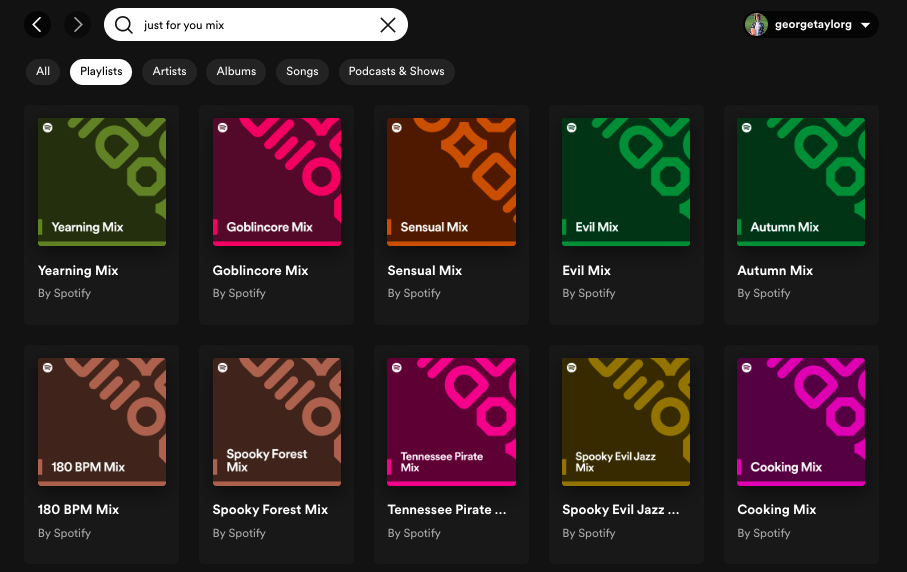
Back in early November, Twitter user @_gaydro posted a picture of their Spotify app showcasing a playlist flatly named “Evil Mix.” The description beneath the automatically-generated playlist cover reads, “Evil music picked just for you.”
People in the comments and quote tweets were quick to dive into their own Spotify apps and report back the most obscure and outright hilarious examples they could find within their libraries. Fast clown music. Spooky evil jazz mix. Tennessee pirate mix. Each title seemed more incoherent and absurd than the last; a gobbledygook combination of nouns, buzzwords, and vaguely musical terms, all denoted as from Spotify and “made for you.”
One Redditor commented on the sheer breadth of dog-specific playlists that Spotify had crafted for him: Calm Dogs Mix, Dogs Calming Mix, Dogs Pet Calming Mix, and more. “I must have searched once for music to help my dog figure fireworks out, and now I am gifted with this kind of variety… If you scroll slow enough, the page just keeps loading, so I don't think there is an end to the algorithm attempting to satisfy your every need,” they observed.
These playlists are essentially an extension of Spotify’s Daily Mix program. In a press release from early 2021, Spotify explains the fuel behind these mixes with an impressive stat, explaining that “every day, half a trillion events—whether they are searches, listens, likes, or countless other actions—take place on Spotify, powering and guiding our machine learning system. This gives us the ability to drive discovery in a way that audio has never seen before.” In their own bland, corporate, grey-cubicle-approved marketing words, “Spotify Mixes represent the next generation of focused, personalized offerings.”
So that raises a few questions, why so many? Who is this for? What the hell is going on? It was a fun day to be online and see what insanely specific playlists people were able to dig up, but I didn’t think much of this phenomenon until I traveled home for the holidays and was poking around the family computer to find that my own mother had saved one of these playlists. Happy Birthday Mix. There it was, staring me in the face. I finally understood.

Those far-out examples of “Goblincore Mix” and “Crazy Bagpipes Mix” are inherently goofy, but these “normal” instances like “Happy Birthday Mix” make much more sense. I can practically see my mom, on her birthday or the birthday of one of my brothers, searching Spotify for “happy birthday,” finding that playlist, and saving it. I mean, why not?
Maybe I’m just being overly precious about “mah playlists,” but it rubbed me wrong to see some algorithmically-generated bullshit garnering attention and listens just because Spotify has created a glut of playlists meant to catch any possible combination of terms a user could type into their app.
In almost every case, these mixes are filled with “just some songs.” The more straightforward playlists will populate with a handful of songs you’ve already listened to and a dozen others that the Spotify Machine Brain thinks you will enjoy. For instance, my 70s Rock Mix (clocking in at an even four hours) opens with “Iron Man” and Tangerine” before throwing to some Heart and Pink Floyd. In these cases, Spotify is serving you music it already knows you like and throwing a few deeper cuts into the mix here and there. That’s where the “made for you” comes in; Spotify is just pulling your own data and serving it back to you under the guise of something specific like “Sensual Noise Mix.”
As you would expect, the goofier playlists are where things get even weirder. The more absurd mixes contain songs that fit their criteria in very literal ways with song titles, artist names, or even album covers that fit the description. For me, “Fast Clown Music Mix” includes songs from a band named Clown Core taken off an album called Van, which has cover art depicting a blue minivan. The same playlist opens with a song off an album called Mirror Might Steal Your Charm, which features a sort of jester-like figure on its cover. Now that sounds like Fast Clown Music picked just for me.

So why does this matter? This technology is still in its infancy, but I believe these mixes are something Spotify is testing to trick their users more effectively. People have no insight into how these playlists are made, what goes into them, or how many of them there are. People just look up a term and are served a loosely-themed collection of music that they’re probably already familiar with. Alternatively, they’re given a playlist packed with a bunch of tangentially-related songs that fit some surface-level criteria.
Where this gets complicated is that Spotify can choose what songs are placed within these mixes with zero transparency. After all, we’re talking about a company that gives out $4 for every thousand plays. They’re notoriously cheap and view the music being uploaded onto their platform as mere content. On the one hand, Spotify is making music more accessible than ever; on the other hand, they’re actively devaluing art.
A couple of years back, Spotify introduced “Discovery Mode,” which is like the platform’s own version of pay-to-play. With this feature, the streaming company borrowed a concept from the days of radio where an artist (or, more likely, label) would pay a station to play their songs more frequently. With this in mind, it’s easy to see how Spotify could manipulate what tracks appear on these playlists and therefore get streams.
Am I saying these bands are fake? Not necessarily, but that is something Spotify has been accused of. By the same logic, it’s easy to see how Spotify could fill hours of these types of playlists with ambient music, “peaceful piano” tracks, and faceless acoustic fare. It doesn’t matter if the artists behind these songs are real because the playlists are meant to fill a specific vibe, mood, or need. Cozy Christmas Music Mix. Dinner Party Mix. Beach Music Chill Evening Mix. They mean nothing.
This could just be the rambling of one overly-concerned overly-online music nerd, but I think that any time Spotify removes the agency out of music consumption, it’s a reason to be wary. Their series of “This Is” playlists are a microcosm of a platform-wide issue of pushing streams (and money) only to the top. Most artists do not turn a profit from Spotify, and that isn’t a sustainable business model.
Tricking people into clicking on (and listening to) an algorithmically-generated playlist of songs is a step further. It’s gaming a system that’s already rigged. It will be fascinating to see what comes of these playlists over the next year or two. I’m interested to see if they become more plentiful, elevated higher within the app, or how often they start popping up over actual playlists and albums made by real humans.
The truth is that Spotify has a vested interest in keeping you on their platform, but even more so if you’re listening to the artists they want you to listen to. They don’t want you to think. Spotify doesn’t want you to search for a small artist or listen to a specific album; they want you to throw on a four-hour-long megamix of music they have already chosen for you. Conscious listening is bad for business, Spotify wants you to devour slop from their trough.
Ultimately, when Spotify chooses what we listen to, we’re not listening to music anymore; we’re just listening to Spotify.
Words on Music and Life.
Swim Into The Sound is an independent music publication. Learn more here or connect with us below.