In Memoriam: Bo Lueders of Harm’s Way

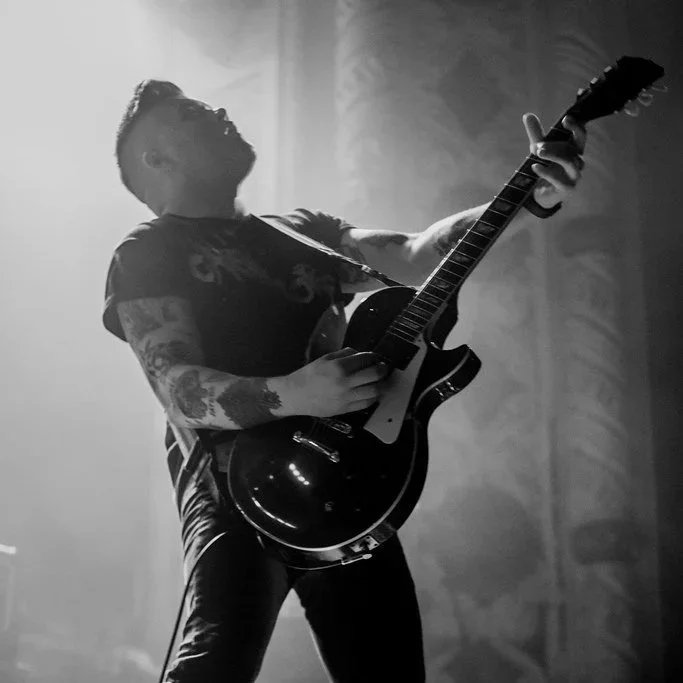
Photo by Mikey McInnis

Growing up going to metal and hardcore shows in Chicago, it almost felt like a requirement to get into Harm’s Way. This wasn’t hard to do; the band are masters of their craft and what I refer to as a “perfect heavy band,” not pigeonholed into any one specific subgenre, but well-versed in all of them. They aren’t just a metal band, or a hardcore band, or a punk band, or an industrial band; they’re all of those and more. Their distinct sound has been established by a rotating cast of members since 2006, but at its core are monster vocalist James “Hammers” Pligge, powerhouse drummer Chris Mills, and thunderous guitarist Bo Lueders, who tragically passed away last Thursday morning.

I did not know Bo personally, but there’s a weird weight to eulogizing someone who is so close to your circle. He was a friend, coworker, and collaborator with many of my friends, coworkers, and collaborators. Not only is Harm’s Way tied for the band I’ve seen the most times in my life, but I would often see Bo attending and moshing at many metal and hardcore shows around Chicago, including Life Of Agony, Obituary, and a handful of times at Riot Fest. He was one of our local celebrities, always repping for Chicago and Chicago bands, which strengthened my connection to him and his music. Bo was Chicago, Bo was hardcore, and most importantly, Bo was Chicago Hardcore.

Despite having mutual connections and similar musical interests, I always felt intimidated to strike up a conversation whenever I’d pass by him. I never wanted to feel like I was bothering him; I just continued to admire his presence from a short distance away. With his podcast, HardLore: Stories From Tour, co-hosted by Colin Young from Twitching Tongues, God’s Hate, and several other metal and hardcore bands, myself and hundreds of thousands of other fans got to learn a ton about Bo and his personal HardLore, and looked up to both him and Colin as trusted voices in our scene. When you hear or see someone on your devices on a weekly basis, it’s easy to feel like you’re close to them in some way, and I think I didn’t want him to feel like I was immediately cool with him just because we knew similar people or because I listened to his band and his podcast. But he always seemed charismatic, bright, and approachable, on and off stage, and on and off screen.

If you are even remotely tapped into alternative or heavy music discourse, you likely saw at least a portion of the immense outpouring of fandom, love, and support for Bo Lueders and Harm’s Way from regular fans and professional musicians alike. Icons like Claudio Sanchez of Coheed And Cambria, Jamey Jasta of Hatebreed, and Freddy “Madball” Cricien, all former guests of HardLore episodes, shared their condolences. Cricien’s was particularly stinging, as part two of his HardLore interview was published just hours before the news broke of Bo’s passing. And of course, Colin Young’s message to his friend, co-host, and brother in hardcore, is as beautiful, sorrowful, poignant, and heartfelt as a tribute can get.

The collected works of HardLore and Bo Lueders’ discography in Harm’s Way, Few And The Proud, Double Crossed, Convicted, Wolfnote, and XweaponX are all worth diving into for the uninitiated. My personal favorite HardLore episode is with Dan Seely of King Nine, and Harm’s Way’s latest album Common Suffering is a note-perfect reflection of everything the band is capable of. I am a proud fan of everything Bo was able to accomplish in his time, and he left a mark on Chicago that will never be forgotten. Rest in peace.

If you or someone you know is struggling with mental health, please use the following resources:
Suicide & Crisis Lifeline: Call or text 988
Crisis Text Line: Text “HOME” to 741-741
National Alliance On Mental Health Helpline: 1-800-950-6264

Donate to Support for Bo's Memorial Service

Ozzy Osbourne Withstood the Darkness

Photo by Ross Halfin

In the end, even Ozzy seemed surprised. It wasn’t the crowd — 45,000 people did show up to Villa Park in Birmingham on July 5th for his Back to the Beginning farewell concert, but that’s light work for the Prince of Darkness, who played to a quarter of a million in 1974. It might have been that after decades of arguments and splits and lawsuits and actual fisticuffs, all four members of Black Sabbath were finally sharing a stage again.

But I think it was something even deeper than that. When the marquee rose high above the stage that night, it revealed the godfather of heavy metal seated on an obsidian throne. (Osbourne had been diagnosed with Parkinson’s disease some years earlier, impacting his ability to walk.) 

“Let me see those fucking hands!” he cried out to all-consuming cheers. As his eyes bugged out and as he swayed with Tony and Bill and Geezer, I think what astonished him was not that he was there, but that he was at all. That decades after he first laid waste to what Rage Against the Machine guitarist Tom Morello called the “hippy, flower-power psychedelia,” he was not only still alive, but able to enjoy the still-flourishing fruits of his labor. 

Just two weeks later, the frontman for Black Sabbath and perhaps the most consequential living figure in rock music passed away surrounded by his family. 

It was not the kind of death that the world expected from him. Millions of inches of column space have been devoted to his on and off-stage antics: eating doves and bats, pissing in record executives’ wineglasses, pissing on a memorial to the Alamo, et cetera et cetera. His long battle with drug and alcohol abuse is also, to put it mildly, well-documented. His first visit to rehab was in 1984, and he appears to have struggled with addiction right up to retirement age, telling Variety that he had relapsed in his early sixties, then quit again around the age of 65.

“I should have been dead 1,000 times,” he said in the interview. “I’m not being big-headed about that, or invincible. It doesn’t take much to kill you.”

Ozzy knew that even before he took up drugs. He’s often described his childhood in industrial Birmingham in the 1960s, which was marked by domestic strife, violence, and poverty. In 2003, he shocked listeners when, in typically frank Ozzy fashion, he disclosed his experiences with sexual abuse.

“Two boys used to wait for me to come home after school. Then they would fuck around with me,” he told the Mirror. “They didn’t fuck me, but they messed about with me. They would force me to drop my pants and all that shit. They felt me and touched me… and it was terrible. The first time it happened was in front of my sister, and that affected me even more. It became a regular thing on the way home from school. It seemed to go on forever."

Ozzy was 11. 

"I was afraid to tell my mother or father,” he said. “My parents would fight a lot, and money was scarce. There were eight of us living in a two-bedroom house. Then that happened and for the rest of my childhood I was forever running with fear.”

It’s still startling to think that fourteen years before #MeToo took hold, a male celebrity spoke about his experiences with sexual assault with that degree of candor. Particularly someone like Ozzy, who built his empire off music that spoke to disaffected, and at times misogynistic and predatory, men. Marilyn Manson, for example, made a video appearance on the Back to the Beginning livestream to profess his love for Ozzy. His inclusion, following multiple allegations of rape and abuse, was a source of confusion and outrage for many fans. 

I don't mean to sympathize with the devil. Ozzy’s associations are weighty. As the center of gravity in the rock universe, any co-sign or even acknowledgement from him translates to clout and money. That those resources would go towards men who (allegedly) choose to abuse others is appalling, regardless of his own experiences. 

I guess what’s been on my mind following Ozzy’s death is how his experiences, in his words, “completely fucked [him] up.” Because what were the options back then for a working-class boy in Birmingham? There weren’t resources for survivors, period. And even if there were, the stigma specifically stalking men and boys who survived sexual abuse likely would have been too great to bear. Even now, in a post-#MeToo landscape, the conversation on male victims usually ends in a punchline.

“When I was a kid, people did not talk about these things like they do now. You didn't have chat shows talking about child molestation,” he said in 2003. "I worked it out with a therapist. But if you have a traumatic experience when you are young, it does fuck you up.”

I doubt it had even occurred to Ozzy at the time that he had been unjustly denied safety, that he deserved recourse. Probably he just folded it into his understanding of the world: people will take advantage of you in the most intimate and barbaric ways, and that’s just how it is. The question — and this is the case, I think, for everyone affected by sexual violence — is how do you make your peace with it?

I wonder if Ozzy ever figured that one out. Beyond sexual violence, he certainly had no shortage of hardship to deal with. He attempted suicide several times as a teen, then fell headlong into drugs and drinking. Even after that interview with the Mirror, he would go on to relapse, which suggests that he didn’t quite “work it out” in therapy. In fact, that question of how to go on seemed to haunt him. Through the decades of altered and muted consciousness, he never took his gaze off the darkness within. 

That fascination both inspired his most creative work and put his life in peril. After he was kicked out of Sabbath in 1979, Ozzy said he took the money from the split and locked himself in a hotel room for three months to do drugs. 

“My thinking was, 'This is my last party, because after this I'm going back to Birmingham and the dole,’” he told Classic Rock.

Ozzy was so certain that this world was not for him — that despite his success, he would eventually be consumed by his own darkness. He was wrong. His greatest power as a musician has always been his ability to sublimate grief and pain into art. I don’t know if Ozzy made peace with his darkness, but I think he did learn that while it’s easy to succumb to it, it’s infinitely more interesting to make something out of it. And if you stick around, you’ll be lucky enough to see what good comes from it. 

Despite it all — despite the drugs, despite the poverty, despite the fear, despite the fights, despite the darkness within — when he mounted that stage, his wide eyes took in all the good. I think Ozzy was surprised by just how good it could be.


Nikolai Mather (he/him) is a writer and musician based in North Carolina. His favorite Ozzy tunes are “Jack the Stripper/Fairies Wear Boots” and the one he did with Miss Piggy. He’s taking a social media break, so reach him at nmather@whqr.org.